Friday, 24 June 2011

Sargent's Children

John Singer Sargent is mainly famous for his portraits - the beautiful Lady Agnew and the louche Madame X spring immediately to mind when his name is mentioned. Far more interesting to me are his paintings of children: in particular the Pailleron siblings, the daughters of Edward Darley Boit and the two Barnard girls lighting lanterns in their garden.

Sargent's children are not sentimental or naively charming. He depicted them as individuals, to be accepted as unique and independent personalities, eschewing the usual conventions of expressing their innocence and purity.Above all, his children are not "cute", like Millais' "Cherry Ripe" and "Bubbles", nor indeed like any of Renoir's lovely children.


"Portrait of Edouard and Marie-Louise Pailleron" was painted in 1881, in their Paris apartment. Sargent, an expatriate American, spent much of his life in Paris and only moved his studio to London after the "Madame X" scandal. But that is another story.


The Pailleron children evince no childish appeal - they look haughtily at the viewer. They display no signs of affection or awareness of each other: it is almost as if Sargent painted two portraits on the same canvas rather that a double portrait of siblings. Marie-Louise is entirely self-possessed and looks almost regal, seated on her pile of oriental carpets. Her father remarked that she looks like "Joan of Arc hearing the voices".


The painting was a critical success at the 1881 Salon - people found it fascinating and read different narratives into it, despite the artist's efforts at keeping it ambiguous. "The Daughters of Edward Darley Boit" shares this tendency of the viewers to read drama into it, to an even greater degree. It almost seems to me like the Rorschach Test: an essentially neutral image on which the viewer projects what is in their own psyche.


"The Daughters of Edward Darley Boit" is a very powerful image. Despite the minimal environment and the absence of "props" on which to hang a narrative, this haunting and enigmatic painting has inspired a multitude of psychological interpretations. Some even postulate that Sargent depicts in it his uncanny premonition of the girls' future spinsterhood. (None of them married.)


No surprise that many of these psychological interpretations look for sexual connotations. (Thank you, Sigmund!) I for one refuse to accept that this picture proves poor old Sargent to be a paedophile, as art historian David Lubin would have us believe! Even Sister Wendy puts a psychological spin on it, looking at the painting as "an image of children lost, isolated from one another, and homeless in their own home." The very title is not exempt: Lubin says it "suggests the possessive power of the father" and he is not alone in commenting on the absence of the mother's name.


The picture is seven foot square, a very imposing presence. It hangs in the Boston Museum of Fine Art, to which the Misses Boit donated it in 1919, together with the tall Japanese vases that now stand on either side of it. Visitors to the museum, some of whom come great distances especially to see it, spend more time with "The Daughters …" than with any of the other paintings in the collection. People respond emotionally to it: some viewers weep.


The girls are depicted in the front hall of their Paris apartment, unfurnished but for two enormous Japanese vases. The Boit family travelled back and forth across the Atlantic from Boston to spend half of each year in Paris. Amazingly, the two fragile and valuable giant vases survived at least fourteen crossings, with nothing but minimal damage to the delicate fluted rims, in the days before the miracle of bubblewrap and polystyrene chips.


The closest to a conventional portrait in the painting, is that of Julia (4), who sits in the foreground in a clear and even light. Mary Louisa (8), stands against the wall to the left, and the two older girls, Florence (12) and Jane (14), are further back, in shadow and not so clearly visible, especially Jane, who is leaning back against a vase, in profile. In the absence of other furniture, the effect of the children being dwarfed by the vases makes for a fantasy effect, evocative of Alice in Wonderland drinking the potion that made her shrink.


The asymmetrical placement of the figures is nevertheless carefully balanced by Sargent's use of light and shade, and of patterns and shapes. The bright figure of Mary Louisa on the left is balanced by the vase and red screen on the right, Julia on her carpet is anchored by the bright reflection of the window in the mirror at the back, and acts as a counterweight to the figures of the two older sisters in the middle distance.


Sargent prided himself on his technical ability with white-on-white, and in this picture he pulls out all the stops, unerringly painting the modulations of all the gradations of light on the starched white pinafores.


Sargent knocked off this picture in only 45 days, and first exhibited it at the Petit Gallery, where its unconventional appearance received mixed reviews. He then exhibited it at the Paris Salon in 1883, with the same result. It was not well received in London, the following year. British viewers considered it "beastly French" and voted it the worst painting of the year in a newspaper poll.


French and English aesthetic standards differed vastly, and Sargent decided to establish himself in London by creating a work that was more acceptable to the English taste. It was important to him to establish himself in London as he had rather burnt his boats in Paris over the scandalous "Madame X" thing.

Sargent achieved his object in spectacular fashion with Carnation, Lily, Lily, Rose, a portrait of Polly and Dolly Barnard. (Honestly - some parents!) Children in a traditional English garden, none of that beastly dark French interior nonsense: London loved it.


Did they not notice how similar it is to the despised "Daughters of EDB"? The ambiguity of scale - the tall lilies, like the vases in "Daughters", tower over the girls; both are studies of light: reflections and half-lights in a French interior, twilight and lamplight in a garden; in both the portraits are secondary to the composition; the girls in both are dressed in white and are posed asymmetrically.


Erica Hirshler calls it "a translation of his portrait of the Boit girls from a French vocabulary into English terms."


I have only been able to scratch the surface of this fascinating subject, but I can highly recommend "Sargent's Daughters" by Erica E Hirshler, from which I gleaned a lot of my information. It is available for loan at the Whitehorse Manningham Libraries.

The Couch Potatoes Go To Britain

Today we are taking the Magic Flying Couch to some of the world's most fascinating museums. Are you sitting comfortably? Then we'll depart. Where's the remote? Ah, of course … it has gravitated into the hand of the only male person in the room. As remotes do. Please press PLAY, good Sir, and transport us to London!


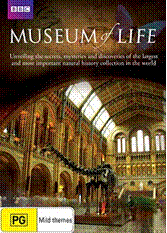
The Museum Of Life is a six-part BBC series that deals with the scientific work that goes on behind the scenes at the wonderful Natural History Museum in London. Anchorman Jimmy Doherty goes behind the scenes with the people who are uncovering secrets, solving mysteries and making discoveries among the 70 million items in the historic collections.

During the series, Jimmy gets to grips with Darwin's finches and Dippy the Diplodocus. He makes field trips with the experts: sky diving for butterflies in Costa Rica; prepping submersibles in Loch Ness; visiting archaeological digs in exotic places.

For me the real star here was the museum itself. It is one of those amazing Victorian public buildings that look like cathedrals. (Only think of St Pancras railway station!) The terracotta tiles and bricks used in the construction feature superb relief sculptures of flora and fauna.

The huge vaulted entrance hall with its sweeping staircases and gothic arches easily contains the 26 metre diplodocus skeleton affectionately known as Dippy. It would take more than the tourist's fleeting visit to see even a fraction of the wonders along the five miles of corridors, but this DVD makes a good stab at whetting the appetite. When next you are in London, put the Natural History Museum near the top of your Must See list!

The Treasures of Britain takes the Magic Flying Couch on to Oxford and Cambridge, where we can inspect some of the treasures in the Ashmolean and Fitzwillam Museums.

The Ashmolean Museum in Oxford is one of the world's oldest museums. This DVD looks at four of the museum's most treasured artifacts. We hear the fascinating stories behind the Egyptian Pharaoh Taharqa's temple shrine from Nubia and the beautifully decorated Octopus Jar from the ancient Palace of Minos on Crete.

I have seen the Alfred Jewel described in many art and history books and films, but I didn't realise that this is where it lives. It is one of the most precious Anglo-Saxon objects in existence. It dates from the 9th century: exquisitely made of gold and cloisonne enamel, it encloses a portrait of King Alfred covered with a transparent piece of rock crystal. A thousand years old and still beautiful! Not unlike Catherine Deneuve.

The Hunt in the Forest by Paolo Uccello was his last painting, made around 1470. A centrepiece of the Ashmolean collection, it is an early example of the effective use of perspective in Renaissance Art.

Cambridge University's Fitzwilliam Museum houses a world famous collection of art and antiquities and offers a stunning introduction to the world's most creative cultures. Here too, we are shown four of their most important pieces.

A rare 13th Century Gothic manuscript that once belonged to the sister of Louis IX of France has the most exquisite illuminations. I don't know how those old monks did those tiny masterpieces, without any of the materials and lighting that we take for granted today.

I found a three thousand year old set of Egyptian coffins made for a high ranking temple official in Thebes intriguing, but my favourite bit of this DVD was the two paintings: Titan's sensuous 16th century masterpiece Tarquin and Lucretia and Degas' haunting picture of two prostitutes, At the Café.

My friend Maarten once remarked that during the years the English owned the earth, they stole everything in it and put it all in the British Museum. He was wrong: they put some of it in the Ashmolean and the Fitzwilliam!

Back on the Couch Again

In this fascinating DVD, British art critic Waldemar Januszczak compares the lives and work of Walter Sickert, the gruff, aggressive "man-of-the-people", and John Singer Sargent, the urbane and charming dandy. There are also interesting cameo commentaries from artists like Jenny Saville, Lucien Freud, and Francis Bacon.


The film focuses on some of the two artists' most arresting (and sometimes alarming!) paintings: pictures of aristocrats and prostitutes, coronations and killings, opera houses and music halls, which evoke the atmosphere of Edwardian London.

Walter Sickert was a pupil and assistant to James Abbott McNeill Whistler and later went to Paris where he was influenced by Edgar Degas. He developed his own version of Impressionism, using sombre colours rather than the bright hues favoured by the Impressionists.

Sickert lived in the East End of London and painted the seamy side of Edwardian life: music halls; sleazy images of naked women and clothed men in dingy London rooms; a series of nudes on dishevelled beds. The one reproduced here, "Mornington Crescent Nude", hangs in the Adelaide Art Museum.

Januszczak dwells on the "scandalous" aspect of each artist's career: the "Camden Murder" in Sickert's case and the "Madame X" fiasco in Sargent's.

In 1908 Sickert painted a series of four pictures, "The Camden Town Murder", prompted by the murder of a prostitute. He was fascinated with murder and in particular with Jack the Ripper. He even painted a dark and sinister picture, "Jack the Ripper's Bedroom".

Among the many theorists about the identity of The Ripper, there are a few, notably Patricia Cornwell, who are convinced that Sickert himself was the psychopathic killer. One of their "clues" was that some of the Camden Murder paintings replicated details of the Ripper murders that at the time were known only to the police … and of course to the murderer.

John Singer Sargent was the antithesis of Walter Sickert: cultured and debonair, he specialised in portraits of elegant society women. He was born in Florence to American parents and traveled extensively throughout Europe. He spent a lot of time in Paris, where he was much in demand as a society portraitist, until the notorious "Madame X" scandal marred his career.

It is difficult for us, 130 years later, to understand what was so scandalous about the whole business that Sargent was shunned by Society, forced to leave Paris and had to re-establish himself in London, just as the scandals of fifty or sixty years ago are baffling to young people today.

My daughter recently asked me why Ingrid Bergman, a great actress, was blacklisted by the Hollywood studios for so many years.

"She had a child with Roberto Rosselini", I said.

"So what was wrong with Rosselini, was he a criminal?"

"No", I said, "he was a brilliant director, but she wasn't married to him at the time."

She looked at me blankly. To a person born in the last 30 years,it is inconceivable that anyone could be ostracised for living together or having a child while unmarried, or being gay, or belonging to a racial minority: things that we who were around in the Fifties can understand only too well.

Virginie Gatreau was an American, married to a Parisian banker. She was a social high flyer, the object of much admiration, gossip and envy, as much for her rumoured affaires as for her beauty. Sargent's portrait of her was not a commission, but rather a request by the artist that she sit for him.

The portrait, originally titled "Portrait de Madame *** " , later shortened to "Madame X" is two and a half metres high, demanding the viewer's attention. Madame Gatreau stands in profile, leaning on a table. In the original version the jewelled strap of her dress is falling off her right shoulder. Sargent later overpainted it, putting the strap back on her shoulder, in a vain attempt to clean the "pornographic" image up a bit.

Public and critics alike lashed out at the artist for what they deemed a scandalous, immoral image. Madame Gatreau's indignant family even threatened to destroy the portrait.

The shock/horror factor seems to have been caused by Mme X's decolletage, the strap falling off her shoulder, and her extreme pallor. Madame Gatreau was in the habit of powdering her neck, arms and shoulders with powder to which a violet tinge had been added, suggesting a louche touch of unhealthy langour. Vampires! Drugs! Sex!

I found the film interesting although I don't care too much for Mr Januszczak's style: he goes off on tangents instead of sticking to the subject at hand. I kept thinking: get back to the story, you only have an hour!

Return of the Couch Potato

I was captivated by the Art Of Spain, a BBC documentary series consisting of 3 one-hour episodes and presented by the genial and erudite Andrew Graham-Dixon. The history of art in Italy always seems to take pride of place, what with the giants of the Renaissance, so it was a real treat to learn more about the genesis of art in Spain.


In the first episode, "The Moorish South", Andrew takes us right back to the art of Muslim and Christian Spain from 711 to 1492. The invading Moors, Arabs from North Africa, took Córdoba in 711 and they made it into one of the great cities of the world. Territorial and political, as well as religious conflicts shaped the history of Spanish art.

The second episode, "The Dark Heart", deals with 16th and 17th century art, while "The Mystical North" looks at art in northern Spain, from Goya to Picasso.

The series discusses all the usual suspects: El Greco, Velasquez, Goya, Miro, Dali, Picasso … the list goes on. But all of that, interesting though it is, is stuff I already knew. What really enthralled me was the wealth of fascinating information about the architecture of Spain, going right back to the Moors.

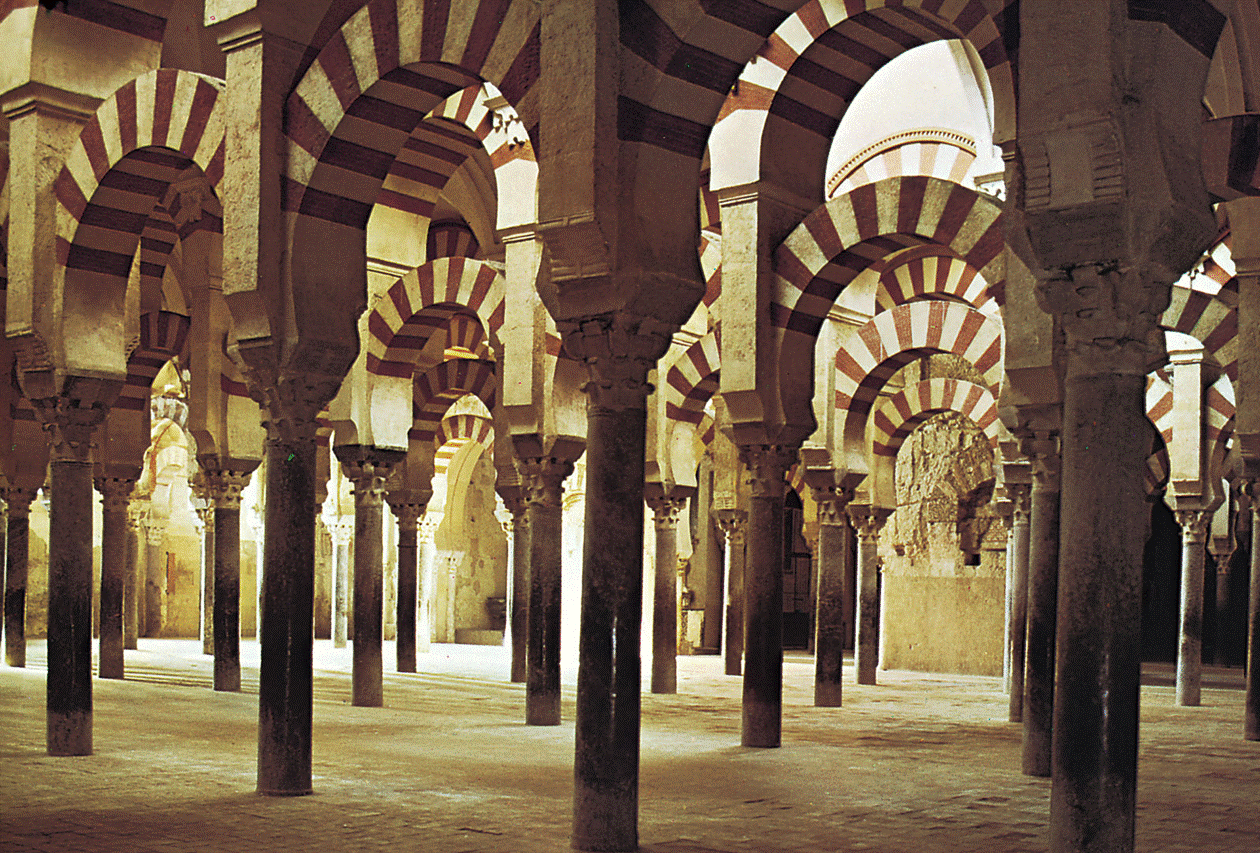
I was enthralled by the forest of arches and pillars in the Great Mosque of Cordoba, which was started in 784 and vandalised by Charles V in the 16th century by imposing a Catholic nave on it.

The Alhambra in Granada with its ornate decoration and water gardens: the stonework looks like lace. How did they do it, without power tools or computers?

The Alcázar Palace in Seville with the amazing tile work, which, as Graham-Dixon puts it, forms "almost hallucinogenic patterns"; the magnificent monastery/palace of El Escorial … there is nothing like these in the rest of Europe.

Another little-regarded aspect of art is the exquisite work of the goldsmiths who made the religious reliquaries which had their origin about the time of St Theresa of Avila's death in 1582. It was part of St Theresa's mystique that an angel appeared to her and pierced her heart with a spear. After her death, her heart was inspected for holes and encased in a bejewelled gold reliquary. On to a good thing, they encased various other bits of her in reliquaries and the game was on.

Our members who have visited the great cathedrals of Europe will have encountered the fingers, toes and thigh bones of various saints and bishops in magnificently decorated gold caskets. I myself have been privileged to see the casket containing the bones of the Three Wise Men in the cathedral in Cologne. Brought back from the Holy Land by Crusaders in the 12th century, I was told. Who am I to argue.

But back to the knowledgeable Andrew: he showed us the architecture of modern Spain: Gaudi's wonderful cathedral in Barcelona, still a work in progress, but then, Notre Dame took over 300 years to build, so it is too early to start tapping the foot and glancing at the Rolex. What I hadn't seen before, is a remarkable block of apartments in Barcelona, like a Disney fantasy. We also had a look at the Guggenheim Museum in Bilbao, designed not by a Spaniard but by Canadian-American architect Frank Gehry: does that count as Spanish architecture? Yes, I suppose it does, otherwise the Sydney Opera House would be Danish architecture, wouldn't it?

Saturday @ the NGV

Last Saturday I went to the ballet matinee at the State Theatre. Like Baldrick, I devised a Cunning Plan! I would go a few hours early, thereby getting a good parking spot under the Arts Centre and as an extra bonus, time to wander round the current exhibitions at the NGV.


I particularly wanted to see ManStyle, the exhibition of men's fashions. I always like the clothes out of the historical novels, and this time there was a beautiful embroidered frock coat and waistcoat in shades of pink: even to an delicate little flower in the centre of each button. I was enchanted.


Less enchanted and more gobsmacked when I moved round to the modern stuff. Where is Paul Keating now that his country needs him? That exhibition needs one of his exquisite suits to leaven the numbing effect of the codpieces, necklaces, skirts and floral headgear that the modern well-dressed man apparently wears. Although where he wears it to, is a mystery to me - I suppose I don't move in the right circles because I haven't so far caught a glimpse of him in his finery.


We have the Vivien Westwood frayed jacket and jeans. with bright red codpiece in the shape of a floppy bow. Right there my freak-out factor started climbing, before I even spotted the Michael Glover miniskirt topped with a sparse kneelength fringe.


OK, so it's a skirt, but it is hessian - that makes it blokey, doesn't it? It is teamed with a hooded top. The hood has a large bobble above the eyes, not unlike Harbhajan Singh when he runs up to bowl one of his off-spinners. Knitted leg warmers and a pair of army boots complete the ensemble.


The House of Rex has contributed an outfit entitled "Nordic Salesman in Swing Dress", complete with an old-time Gladstone bag containing what I take to be his samples. He is wearing what the card says is a "showgirl choker", and indeed it wouldn't be out of place in Las Vegas. Whatever Nordic delights he is selling, he won't get a foot in the door chez McClelland! He'll be lucky if I don't call Simon Overland's Finest. Who? Oh, sorry, I forgot.


By this time I had been joined by the invisible presence of my late father, a man who never owned a pair of shorts or a collar-less shirt in his life. He muttered what could be either prayers or obscenities while we contemplated an ensemble that was conceived in Antwerp: it featured an overskirt with four flounces and a scaly green alligator handbag attached to the shoulder.


And when I say alligator bag, I mean it looked like an alligator. It clung on with its teeth. It reminded me of a fox fur cape my mother used to have in the days before animal rights. The clasp in the front looked like a fox head biting its own paw. I wonder what happened to it … I could probably get a fortune for it on eBay.


My favourite ensemble was the one called "Plain Jane". I was only disappointed that her (sorry, his) "Fancy Fanny" outfit wasn't also on display: that would have been something to see! Reading from north to south, Plain Jane was sporting a knee-length tunic in a snakes-and-ladders print, garnished with a necklace of bright red beads the size of golf balls; floral stove-pipe trousers and a pair of white ballet flats.


There are many more outfits here to boggle your mind. It is still on until November - next time you are at the NGV, pop up to the Fashion and Textile Gallery on the second floor for a look.


After a restorative cup of peppermint tea and an Anzac biscuit in the Members' Room, I ventured up to the third floor to inspect the exhibition of photographs from the NGV archives, under the title of "Deep Water".


The photographs range from icebergs, lakes and waterfalls to beaches, swimmers and boats. I particularly liked the turreted iceberg by Frank Hurley and the bathers at Newport by Max Dupain.


In "Rowing Home" by P.H.Emerson, the oars create fascinating geometric reflections, and I liked "Shark's Eye View" by Narelle Autio: surfers waiting for the next big wave.


These photographs will still be on display until 11 September, so you have plenty of time to see them.

Mrs Delaney

"Nanna Power!" shrieks the headline in my morning newspaper. It seems that three old ladies went ninja in a Malvern parking lot, routing a would-be bag snatcher.
 
Nanna Power is nothing new: more than three hundred years ago, Mrs Mary Delany started her remarkable artistic venture at the age of 72 and only stopped creating her masterpieces ten years later, when her eyesight failed.

Over that decade she created 985 magnificent mixed-media collages depicting flowers. The collection is housed today in the British Museum: ten large albums known as the Flora Delanica. The pictures are not only beautiful, they are botanically correct. Indeed, Sir Joseph Banks declared that these collages were ‘the only imitations of nature that I have ever seen from which I could venture to describe botanically any plant without the least fear of committing an error'.


Mary Granville was born in 1700 into an aristocratic but impoverished family, who recouped their fortunes by marrying her off at the age of 17 to Alexander Pendarves, a rich geriatric with poor personal hygiene and a penchant for the bottle. Mary's letters to her sister describe him as her jailor, “disgusting,” "dirty" and “excessively fat”. One can only hope that his age and alcoholism prevented too many conjugal demands on his teenage wife.

Luckily his dissolute lifestyle made her a childless widow at 25 and for the next twenty years Mary enjoyed her independence. Widows in Georgian times had freedom which married ladies and spinsters did not.

She carried on a voluminous correspondence with her sister, which is why we know a lot about her today. Her life reads like a Georgette Heyer novel: she socialised with people like Jonathan Swift, Handel and Samuel Richardson, went to balls and assemblies, and received many proposals of marriage. She flirted and danced, but she would not accept anyone until she met Jonathan Swift's friend, Dean Patrick Delany, when she was 43. He was a Protestant Irish clergyman. Her family was outraged that she would marry beneath her, but she didn't need their permission and besides, she didn't think they had a good track record of choosing her husbands.

It was a very happy marriage - the couple, who shared a love of plants and natural history, lived at Delville, the Dean's 11-acre estate near Dublin. They created a wonderful landscaped garden, incorporating a bowling green, terraces, flower walks and fruit trees. There was a grotto and an orangery and fields where deer grazed.

When the Dean died after 25 years of marriage, Mary was traumatised. She went to stay with her dearest friend, The Duchess of Portland, at Bulstrode, the ducal estate in Buckinghamshire. It was here that she found a renewed interest in life when she discovered "a new way of imitating flowers", as she wrote to her niece in 1772.

She saw a geranium petal fall on to the dark surface of the table at which she was writing, and it struck her that the colour was the same as a piece of red paper lying on the table. She cut a twin petal out with her embroidery scissors and showed them both to the Duchess, who couldn't pick the real one.

That was the beginning of what she called her "flower mosaicks". They were collages, using coloured paper and sometimes parts of the actual plants, which she dissected with a scalpel to see exactly how they looked. She mounted all her "mosaicks" on a black background, which made them stand out in glowing colours.

The Duchess had one of the greatest natural history collections in the country at Bulstrode but Mrs Delany also received specimens from the Royal Botanic Gardens at Kew, and had seen the floral specimens that Captain Cook brought back from Australia. As her fame grew, many botany enthusiasts sent her specimens to copy. She was persona grata with King George III and Queen Charlotte, and visited them at Kew. They greatly admired her work and also provided her with specimens from the royal gardens and hothouses.

Considering the tools and materials she had to work with, the exquisite and accurate pictures that she produced are astonishing. For a start, she couldn't pop out to the art suppliers for a few sheets of assorted coloured papers, glue and a Stanley knife.

The thousands of “the tiniest dots, squiggles, scoops, moons, slivers, islands and loops of brightly colored paper” that she glued onto the black backgrounds, all had to be made from scratch. In fact, she had to make the background itself first. She would paint a sheet of rag paper with black pigment which she made using tar, pitch, soot and charred bones to get that deep black she wanted.

The coloured papers for cutting out were obtained by painting with water colour the handmade rag paper which was all that was available at the time. Watercolour? Not commercially available until long after she stopped working. Pigments had to be ground in a pestle and she would have to experiment to discover the best proportions of gum arabic, water, ox gall and/or honey to mix them with.

We assume she used egg white or a glue paste of flour and water, but the conservators at the British Museum are reluctant to damage a mosaick in order to get a chemical analysis. Amazing enough that whatever she used still holds it all together!

She used surgical scalpels, razors and long-nosed scissors, embroidery bodkins and tongue depressors. Young ladies of her day were taught to cut out delicate silhouette pictures, and that experience must have stood her in good stead.

Photographic reproductions of her pictures look like paintings - it is only when you go to the British Museum's website and zoom in to a magnified image that you can see the complicated overlapping layers that make up the details.

It was Mrs Delany's ambition to complete a set of 1,000 mosaicks, but her failing eyesight threw a spanner in the works. Next to a good stationer, an optometrist is what she could have used!

I can recommend Molly Peacock's book "A Paper Garden", which is available at all good bookstores and libraries. Mary Delany's story is a fascinating insight into Georgian society and the illustrations are magnificent.


Tuesday, 29 March 2011

Angelica Kauffmann

Why do great male artists, especially those pre-World War 2, far outnumber the women? It took courage for a woman to be independent and practice a profession in her own right - a woman's rightful place in society was to be dependent upon and obedient to her father, until that role was taken over by her husband. Who knows how many potential great talents were lost to the world because they were females and kept in "their place"?

Nevertheless, there have been some outstanding women artists, going right back from modern times to Artemisia Gentileschi and Sofonisba Anguissola in the sixteenth century.
Angelica Kauffmann (1741-1807) was fortunate in having a father, the Swiss painter Joseph Johann Kauffmann, who encouraged her burgeoning talent. Her mother died when she was very young, and she accompanied her father on his travels in Austria and Italy. He allowed her to assist him by painting the backgrounds of his works, but she received her first commission at the age of 13, and soon established a reputation in her own right.

She was a child prodigy - spoke Italian, French and English as well as her native German and she was also musically talented. She played several instruments and had an exceptionally sweet singing voice. Her painting was greatly admired, but she was an attractive girl and enjoyed great personal popularity as well.

She travelled extensively in Italy, spending long periods in Rome, Venice and Milan. She preferred to paint historical and mythological subjects, which was considered to be the only important artistic genre, and did so in a neo-classical style.


However, she was much in demand among the upper crust as a portraitist.Her portrait of the influential German archaeologist and art historian Winckelmann was greatly admired, not least by the sitter, and led to a plethora of commissions. In Venice, she was befriended by Lady Wentworth, the wife of the English ambassador. Lady Wentworth persuaded Angelica to go to London with her, where she was very well received in Society, and became a favourite of the royal family.


One of the first portraits she painted in London was of the actor David Garrick, which was exhibited at "Mr Moreing's great room in Maiden Lane."


Sir Joshua Reynolds, who called her "Miss Angel", was a good friend, and they painted portraits of each other. Under his auspices, she was one of the founder members in 1768 of the Royal Academy, an institution then not famous for welcoming female members. She was one of the artists appointed by the Academy to decorate St Paul's Cathedral and also the Academy's lecture room at Somerset House.


In her early twenties, she was duped into marrying a con man who pretended to be a Swedish count, but Reynolds helped her to obtain a legal separation. When the spurious Count died in 1781, she married Antonio Zucchi, a Venetian artist, and went to live with him in Rome. She was widowed after fifteen happy years of marriage, but continued to work and to enjoy great prestige.


When she died in Rome at age 43, her splendid funeral was directed by Canova. The entire Academy of St Luke, plus all the celebrities of the day, followed her to her tomb and some of her best pictures were carried in the procession.


Her work has not really stood the test of time - the neo-classical works are regarded as sentimental and her portraits are considered to lack variety and expression. However, her works are still exhibited in the collections of many of the world's top museums, among others the National Gallery in London, the Hermitage, the Uffizi and the Alte Pinothek in Munich.

The Art Lover as Couch Potato

Recently, I recommended some documentary DVDs on art and artists, but because Marcia keeps me on a short leash, I had no room then to talk about some of my favourite biopics. So let's take a look at a few of those movies - are you sitting comfortably? Then I'll begin:


Many of our older members will fondly remember those two popular dramas of yesteryear, Lust for Life (1956) and The Agony and the Ecstasy (1965) which dealt with Van Gogh and Michelangelo respectively.

Lust for Life starred Kirk Douglas as Vincent: a remarkable performance that netted him an Oscar nomination. He even looked like Vincent! Sadly, and to my mind unfairly, he was pipped at the post by Yul Brynner for The King and I. However, Anthony Quinn, who played Vincent's friend Paul Gauguin, did get an Oscar for his supporting role.

Lust for Life was filmed largely on location in France and is noted for its beautiful cinematography. Several art museums kindly allowed original works in their collections to be photographed. These, in addition to copies that were painted by Robert Parker, depicted Vincent's canvases in the movie. Altogether a beautiful and well-reasearched film.

The Agony and The Ecstasy, starring Charlton Heston as Micelangelo, is based on the eponymous novel by Irving Stone. Its focus is the stormy relationship between the artist and Pope Julius II, who commisssioned him to paint the Sistine chapel ceiling. Rex Harrison, fresh from My Fair Lady, played the Pope. My brain kept superimposing Raphael's sublime portrait of Julius II on the Harrison features. I didn't want to see Professor Higgins in a red robe discussing theology and art with Michelangelo.

The sets of the Papal and the Medici palaces are lavish and the costumes are beautiful - one gets a real sense of what Rome was like in the 16th century. I learnt a lot about the technique of fresco painting, too!

Still in Rome, we turn to Derek Jarman's Caravaggio. Derek Jarman requires a strong stomach at the best of times: he never shrinks from depicting the sordid details. The life and times of Caravaggio gave him lots of scope: sex, violence, crime, art, corruption - all grist to his mill. The central theme is Caravaggio's relationship with the urchin Ranuccio (Sean Bean) and the prostitute Lena (Tilda Swinton), who were his models and lovers. Jarman uses dramatic chiaruscuro lighting, so that the whole movie looks like Carvaggio's paintings and indeed recreates many of the famous works as tableaux vivants.

I recently saw Love is the Devil, directed by John Maybury, with Derek Jacobi giving a memorable and disturbing performance as Francis Bacon. Daniel Craig plays George Dyer, who came to burgle Bacon's apartment and stayed to become his lover, model and muse. Tilda Swinton, fresh from playing a prostitute in Caravaggio, puts in a creditable turn as the barmaid at Bacon's favourite pub, where he consorts with his dodgy friends.

The film is dark and unsettling, like Bacon's paintings. The artist's estate refused permission for any of Bacon's paintings to be shown in the film, but, as in the Caravaggio film, several scenes are recognisable as Bacon paintings. There are also other echoes of his work: Jacobi is often seen preening in a triple mirror, echoing the triptyches Bacon likes to paint; Maybury uses odd camera angles and distorted views to give the film the Francis Bacon look.

Pollock, directed by its star Ed Harris, tells the story of Jackson Pollock's last years, from his meeting with his future wife, painter Lee Krasner, until his death in a car accident at the age of 44.

Ed Harris devoted years to this project and learned to turn out credible drip paintings, almost indistinguishable from Pollock's own work. Harris, who bears a remarkable physical resemblance to the artist, convincingly depicts Pollock's struggle with depression and alcoholism and the passionate way he painted. This film left me with a new appreciation and understanding of the Pollock oeuvre!

But enough of the sordid tales of Caravaggio, Bacon and Pollock - let's have a look at the tranquil world of Jan Vermeer. Tracy Chevalier's novel The Girl With the Pearl Earring was beautifully filmed by Peter Webber in 2003 and the DVD is well worth another look even if you saw it on the big screen at the time.

What could be more delightful than the luminous Scarlett Johansson and the elegant Colin Firth (who, to me, will always have a whiff of Mr Darcy about him.) Every shot in the film has the Vermeer look and I was charmed by the scenes of Delft, a lovely town that looks today exactly as it did when Vermeer walked its cobbled streets.

Peter Greenaway's Nightwatching is an intriguing fictionalised account of the creation of The Night Watch by Rembrandt. Greenaway posits a fascinating conspiracy theory involving murder, rape and corruption among the leading Amsterdam families. Faintly echoing Dan Brown, he points out coded references to the conspiracy in each of the 34 characters depicted in the painting.

The film goes on to trace the downturn in Rembrandt's fortunes, leading to his eventual bankruptcy and death, all as a result of revenge by the aristos whose peccadilloes were revealed by the artist in his great painting.

Sunday, 30 January 2011

Sunday at the NGV

I like to go to the movies on a Sunday, but given the preponderance of kiddieflicks during the school holidays, I decided last week to go to the NGV instead. They don't replace the Rembrandts and the Van Dycks with Disney and Spiderman during December and January.


First up I had a look at the collection of contemporary New Zealand works on loan from the Queensland Gallery of Art. The exhibition is called "Unnerved" and it does indeed engender a feeling of unease. Among the sculptures, drawings and paintings on display, there were several sets of emotionally provocative photographs:

I was intrigued by a series by Anne Noble of her daughter's open mouth: a piece of string round her teeth, strange objects between her lips or her tongue brightly coloured. (I presume her mum gave her coloured lollies to suck!)

I found Yvonne Todd's series of photographs entitled "The Dark Side of Beauty" definitely disturbing - especially the portrait of a young girl in a slightly tawdry lace gown gazing resignedly at the lens: I thought of vampires and Victorian brothels and the Lolitas forced into polygamous marriages.


Among Greg Semu's pictures I was drawn to a self portrait in which Greg displays his pe‘a tattoo, which is very painfully executed over a period of weeks during the rite of passage to adulthood for Samoan males. Eat your heart out, Mitchell Johnson!

An arresting series of larger-than-life portraits by Lisa Reihana occupied an enclosed space of their own - the enclosure is dimly lit and evokes a place of worship, the portraits themselves dramatically spotlit and imparting a sense of awe. Her subjects portray mythological Maori deities.

Among the most striking is "Maui", a Hercules-like hero, and "Mahuika", the fire goddess who carries flame in her fingernails.
Limited space precludes me from mentioning more works in this fascinating exhibition, but I have to mention Michael Parekowhai's larger than life-size work, "The Horn of Africa" - a seal balancing a grand piano on its nose. I could only think that it references Jane Campion's award-winning NZ drama "The Piano" and the savage tragedy of seal hunting in NZ waters.

Unnerved is still on until 27 February - see it if you can!


The remarkable collection of ceramics, principally Minton, gifted to the NGV by Dr Robert Wilson, is in the long mezzanine gallery overlooking the great hall. I do not know a lot about glass and ceramics, but, as the cliché has it, I know what I like! And there is a lot to like here.

Exquisite Parian ware figurines, a beautiful, asymmetrical Japanese tea service in its decorated case which is a work of art in itself, a chandelier worthy of hanging in a palace, plates and vases magnificently decorated by outstanding designers.

I liked the whimsical teapot shaped like a guy wearing a beret. When I was a little girl in nursery school, we assumed that exact position when we sang: "I'm a little teapot, short and stout / Here is my handle and here is my spout …" 

I am not knowledgeable enough to discuss this collection in detail, but I recommend that you take a look next time you are at the NGV. It is a feast even for the untutored eye, and the notes next to each piece are very informative.

The collection will be on display until 1 January 2012, but don't put off going - time has wings!