Sunday, 13 July 2014

How To Live Forever

Mary Cassatt frequently used Sara,
a little girl form her local village,
as a model.
Never mind the Philosopher's Stone. The road to immortality lies through the palette of a great painter. The models of the Masters live for centuries.
Sometimes the models are anonymous: Carvaggio chose his models from the streets of Rome – the saints we see, may be pickpockets or prostitutes or respectable citizens: we'll never know the stories behind the faces that look at us across a five hundred year gulf.
Rembrandt: Two Old Men Disputing
NGV, Melbourne
Some nameless regulars we come to recognise, like the old man who sat for St Peter in Rembrandt's Two Old Men Disputing, a treasure of the NGV. Both Rembrandt and Jan Lievens, with whom he shared a studio in Leiden, used the old bearded guy numerous times – he is always popping up in their work as various saints, apostles and prophets. Walk into any great art museum that has a Rembrandt or a Lievens, and you are likely to spot the venerable patriarch. He was probably just an old pensioner from the almshouse down the road, making a few stuivers by posing for the lads in the studio … little did he know that his real wage was not the few coins, but immortality.
Suzanne Valadon (Renoir)
Many of the models of the Impressionists have colourful stories. Suzanne Valadon was both a model and an accomplished painter in her own right.  She started her career as a circus performer, but after a bad fall, she took to modelling.  She was a favourite model of Renoir, who painted her many times. Degas encouraged her to paint and gave her lessons.

The job description of Model To The Impressionists did seem to include bedmate-duties. Suzanne is the mother of the painter Maurice Utrillo, but his paternity is uncertain. She told Miguel Utrillo, a Spanish artist for whom she had also posed, that she was pregnant but that she was unsure who the father was. He willingly signed a legal document acknowledging paternity, saying 'I would be glad to put my name to the work of either Renoir or Degas!'

Symphony in White
(Whistler)
Jo Hiffernan, "La Belle Irlandaise", was 'n beautiful Irish woman who modelled for some of Whistler's most famous paintings, notably the Symphony in White. She was his mistress for years, until he left her for a younger model (as they do). This was Maud Franklin, by whom Whistler had two daughters, leaving her in the lurch when she was pregnant with the second child. Still, perhaps the distress she suffered was worth it: still pretty after 150 years, Maud lives on in the Freer Gallery in Washington, as  Arrangement in White and Black.
Arrangement in Black and White
(Whistler)
After Whistler left Jo, she kindheartedly took in and raised his son Charles, who was the issue of a brief fling he had with Louisa Hanson, a parlour maid. Not exactly a prince among men, Whistler, for all that he loved his mum.
Les Dormeuses (The Sleepers)
Gustave Courbet
Jo went on to model for (and sleep with) Gustave Courbet. She was the model for two of Courbet's most famous works, Les Dormeuses and The Origin of the World.  Both were notorious at the time: the former because of its lesbian theme, and the latter because it is a close-up of Jo's nether parts. They are no eyebrow raisers today – you can see much worse on the internet any time you like. And, sadly, so can your ten-year-old.
The Origin of the World
(Gustave Courbet)
Chloe
 
Marie was a Parisienne model who was famous enough at the time to be known by only the one name, like Madonna or Cher. She was nineteen when Jules-Joseph Lefebvre used her as the model for Melbourne's iconic Chloe. He also seduced her and then abandoned her, moving on to new conquests. Marie died at 21 in distressing circumstances, but as Chloe she graces the walls of Young and Jackson's, still full of charm and beauty after 150 years.

Friday, 4 July 2014

"Say Cheese!" ... Iconic Photographs


Marilyn Monroe in The Seven Year Itch


Photography has come along way since Louis Dagurerre started fiddling with his silver salts and iodine crystals in 1826. Thanks to technological advances, even beginners can turn out lovely photographs. There is no shortage of interesting and beautiful pictures for us to post online, where they ricochet back and forth endlessly between friends and strangers in e-mails and social media.
 
Among the countless images, there is a handful that absolutely stands out. Once seen, never forgotten. Here are some of them.


Man Ray's Le Violon d'Ingres (1933) is, as the title suggests, an homage to the painter: he pays tribute to the Ingres nudes, in particular The Bather and The Turkish Bath, but the photograph is also a visual pun that refers to the fact that Ingres was a talented violinist. Man Ray photographed the model Kiki in a turban, then painted the f-holes on the print and rephotographed it. Her arms are hidden, to emphasise the resemblance between the female shape and that of a violin.
Ingres: The Bather
 
Also from the 1930s is the photograph by Charles C. Ebbets of eleven construction workers, nonchalantly  seated on a girder eating lunch, 260 meters above the streets of New York. The picture was taken in 1932, during the building of the RCA Building at Rockefeller Center. No safety harnesses: I suppose OH&S wasn't much of a concern back then. The country was in the grip of the Great Depression, and perhaps people were desperate enough for work to disregard safety issues.


You don't have to be an acrophobic to remember this one!

This photo, taken during the roundup of Jews after the Warsaw Ghetto uprising in 1943, is perhaps the most emblematic one of the Holocaust. The picture is part of the official SS report on the "police action", which consisted of the destruction of the ghetto and the transportation of the people to Treblinka, where they were gassed. 


The seven-year-old boy with his hands up (in case he attacked the soldier with the gun?) is an unforgettable and heart-wrenching image. Some of the faces in the picture, including the soldier pointing the gun, have been identified. The little boy's identity is still a mystery. He may or may not  be Arthur Chmiotak, gassed at Treblinka, or Tsvi Nussbaum, who survived and eventually reached the US via Israel. Over the years several fame-seekers have claimed to be the boy, but their stories have all been disproved.


The award-winning Afghan Girl by Steve McCurry is sometimes called "the Third World's Mona Lisa". The photograph was the cover picture of the June 1985 issue of National Geographic Magazine.  

Her identity remained a mystery until 2002, when a National Geographic team travelled to Afghanistan to try and find her. Until then, the country was pretty much closed to Western journalists by the Taliban.

She was positively  identified, through iris recognition technology, as Sharbat Gula, twelve years old when the picture was taken. At 14,  she was married off to Rahmat Gul, with whom she lives in their remote village in Afghanistan.

They have three daughters and Sharbat hopes that they may someday be allowed to get an education.  So do I.

A young photography student, Robert Wiles, took this photograph just minutes after Evelyn McHale leapt to her death from the Empire State Building in May 1947.
Wiles was struck by her beauty as she lay, like Snow White, in the "bier" that the impact of her body had sculpted out of the roof of a Cadillac. Contrary to what one would expect after a fall from such a great height, there is no blood, no mutilation. Her skirt is decorously in place, her eyes are closed and her face serene, as if she is asleep. One elegant white-gloved hand is touching her pearls.

Robert Wiles named the picture "A Beautiful Death". LIFE Magazine published it in that month's issue. The image captured the imagination of the public and was endlessly reproduced. Andy Warhol included it in his "Death and Disaster" series.

Evelyn's suicide was an enigma: she was 23 years old, recently engaged to be married, and the cryptic letter she left behind did not explain her motive, merely saying "Tell my father, I have too many of my mother’s tendencies.”  Ironically, she added: “I don’t want anyone in or out of my family to see any part of me. Could you destroy my body by cremation? I beg of you and my family – don’t have any service for me or remembrance for me." 
Evelyn was not to have her last wish. Her picture and the remembrance of her tragic beauty live on. 

There are so many more iconic photographs that have become part of our collective memory: the mushroom cloud of the first atom bomb; Sherpa Tensing on top of Mount Everest; our planet seen from the Moon, like a beautiful blue marble; Neil Armstrong in his space suit; Marilyn with her white dress billowing up; Jackie Kennedy with her husband’s blood on her pink suit; little John Kennedy saluting his father's coffin; The man with the shopping bag in Tiananmen Square; the sailor kissing the girl on the day WW2 ended; three Marines raising the flag on Iwo Jima ... And how about the fire-fighter giving the koala a drink on Black Saturday in 2009?  Magic!

Wednesday, 18 June 2014

Painting Cats


It is at least five thousand years since cats graciously condescended to live among us. In that time, we have paid homage to their grace and beauty in art, music and literature. 
Great artists, from Leonardo to Picasso, have painted cats. For the delight of my fellow-ailurophiles, here are just a few of the painted cats that I like.


Giovanni Lanfranco: Young Man Lying on a Bed with a Cat (c.1620)
An enigmatic and provocative picture, thought to be a self-portrait. The young man's smile and direct gaze seem to hold an invitation, in an intriguing gender role reversal. The tone and feel of the painting is reminiscent of Velasquez's "Rokeby Venus" or Ingres' "Grande Odalisque".  The cat he is stroking, adds to the sensuous mood.


John Everett Millais: A Flood (1870)
             This painting was inspired by the story of a baby in its cradle, swept away by the water during a great flood disaster in Sheffield. The child seems unconcerned by the danger and is entranced by the birds in the branches above her. The cat, who has hitched a ride on this little ark, is fully aware of the peril and her mouth is open in a terrified miaow. True to Pre-Raphaelite form, the picture has a Biblical flavour, evoking both Moses and Noah.


Paul Gauguin: Where Do We Come From? What Are We? Where Are We Going?  (1897) detail
This detail is from the huge (5’x 12’)  painting considered to be Gauguin's masterpiece. The painting is populated with figures symbolising our journey through life and the animals with whom we share the world. The fundamental questions about the meaning of life remain unanswered (unless you are a devotee of Douglas Adams, in which case you will know the answer is 42.) 

Pierre Auguste Renoir: Julie Manet (1887)
Julie was the daughter of Berthe Morisot and her husband Eugene Manet, younger brother of the painter Édouard Manet. As a child and an adult, she posed many times for her mother, her uncle and their Impressionist associates.
This portrait was done during the period when Renoir experimented with a style like that of Ingres, characterised by vivid colours, meticulous line and drawing, and an enamel-like finish. Julie herself thought it a good likeness, but Degas didn’t like it:  "by doing round faces, Renoir produces flower pots", he said.  


Sophie Gengembre Anderson, Awakening (1881)
Sophie, a Frenchwoman married to a Scot, lived in London where she was influenced by the Pre-Raphaelites. She specialised in children’s faces and genre pictures.  Some of her paintings veered toward the fey and faerie, so beloved of Victorian middle class taste. This double portrait of cat and girl, both gazing trustingly at the viewer, has an air of gentle affection. Her realistic style and genre subjects remind me of a Victorian Norman Rockwell. 
Suzanne Valadon: Study of a Cat (1919)
Suzanne Valadon,
who modelled for and was the lover of many of the famous Impressionists (Dégas, Toulouse-Lautrec and Renoir among others), was a formidable artist in her own right. She painted landscapes, still lifes and female figures, frankly naked in an unashamed way that was shocking at the time.
She loved cats and painted many pictures of her own Raminou, including this one of him on the chair which looks so much like the one in Van Gogh's bedroom.
I can recommend "Suzanne Valadon: Mistress of Montmartre", by June Rose – an absorbing biography  of a fascinating woman. 
Mary Cassat: Sara Holding a Cat (c.1907-08)
Mary Cassat  was American but lived most of her adult life in Paris, where her art could flourish. With Berthe Morisot, she was one of Impressionism’s Grande Dames.
One usually associates  Cassat with "mother-and-child" pictures, but she also painted many single children, using children from her local village as models . She painted Sara several times, her sweet face and agreeable nature making her a perfect model.
Sara's gentle cuddling of the kitten and her tender look evokes Cassatt's leitmotif  of mothering.
 
Théophile Steinlen: Two Cats (1894) 
This picture of two elegant Art Nouveau cats is a poster by Steinlen for an exhibition of his prints and drawings. He worked closely with Toulouse-Lautrec and the two of them were the first great poster artists. Steinlen’s first and most famous poster (see top of page) is of the iconic black cat, advertising “Le Chat Noir”, the first nightclub/cabaret in Paris.


Giovanni Boldini: Girl with Black Cat (1885)
Like his contemporary, John Singer Sargent, Boldini was a fashionable portrait painter among the Great and the Good of Paris and London.
I love this picture, which is as much a portrait of the cat as of the girl. It is full of energy as she leans her weight backward to balance the rather large cat who is trying to escape from her arms. He already has one paw free and his stern gaze says: “Look out, I’m going to deploy claws any minute now!
I can recommend “The Cat in Art” by Steffano Zuffi. In it, you will find all the above cats and many more.


Saturday, 24 May 2014

The Likely Lads


National Gallery, London
Anthony van Dyck
Lord John Stuart and his Brother, Lord Bernard Stuart  (c. 1638)

 
This pair of aristocratic siblings, cousins to King Charles I, were immortalised by Van Dyck in one of his superb life-size double portraits.  They were the youngest sons of  Esmé Stuart, third Duke of Lennox.

They sat for Van Dyck in 1638, when they were 17 and 18 years old. The paint was still wet when they left  England to make a three-year tour of the Continent: the traditional "Grand Tour"  that was de rigeur for scions of the nobility and wealthy landed gentry.

The boys came back from their quest for European culture just in time to join their regiments in the King's cause, at the start of the Civil War.

Lord John was given command of a cavalry brigade under the the Earl of Forth. On 28 March 1644 the Earl's army engaged the Parliamentarians at Cheriton Wood, near Winchester. In the ensuing battle, Lord John was slain.
 
Bernard was Commanding Officer of the Guards Regiment raised by King Charles I when civil war loomed. He distinguished himself at the battles of Newbury and Naseby, for which the king decided to create him Earl of Lichfield. Sadly, he did not live to receive the earldom: he was killed while leading a sortie against besieging forces at the Battle of Rowton Moor, on 24 September 1645.


Lord George Stuart
An older brother, George, whom Van Dyck had also painted, died of "grievous wounds" received in a pitched battle at Edgehill on Sunday 23 October 1642. All three brothers were 24 years old at the time of their deaths.

Anthony van Dyck was a dab hand at silk, lace and satin. Just look at his portrait of Rachel de Ruvigny, Countess of Southampton, in the NGV.  Those billows of shimmering blue satin! He was known to use hand models for the elegantly tapering fingers he invariably gave his sitters, but he was very good at depicting his subjects' facial features accurately, even if he sometimes flattered them a little. Have to please the paying customers!  


The Countess of Southampton
Antony van Dyck, NGV
The family resemblance here is unmistakable. The simple background sets off the young lords' aquiline features, confident poses and opulent garments. This picture puts me in mind of Stubbs' Whistlejacket, where he depicts the beautiful thoroughbred horse, with his rich, glossy chestnut coat, against a plain background. Van Dyck does the same with these two lads, who are just as beautiful, rich, glossy and highly pedigreed as the horse.


Whistlejacket by George Stubbs
National Gallery, London
They are the epitome of romantic, long-haired, swaggering cavaliers - Lord Bernard, on the right, looks down his nose in snobbish disdain. Lord John, a more introspective figure, is posed on a step to make him appear taller and more important than his junior.

Lord John's gold and bronze complements the silver and blue garb of Lord Bernard, just as his  smooth, long hair sets off the other's curls. Bernard turns back his cloak to display the silk lining, and he casually shows his kid gloves – both items were hideously expensive and a hallmark of wealth. An interesting fashion note is the flat sole connecting the high heels to the front of the shoe, to prevent sinking into the mud when walking outside.

Seeing these young men so arrogant and confident in the prime of their youth, it is tragic to know that they had only five years to live – despite their foppish appearance, they both died fighting bravely for King Charles.
 
To me, their portrait is just as poignant as the photographs of young Diggers on the eve of departure for Gallipoli, for Vietnam or for Afghanistan. Young, eager and confident ... at that age, they know they are bulletproof.  All the anxiety and apprehension is left to the mothers!
 

Saturday, 17 May 2014

South African Cuisine

Table Mountain at the Cape
There is no single South African cuisine. The different ethnic groups cooked according to their traditions. However, significant cross-pollination has occurred and many of South Africa's most popular dishes are hybrids of the various cuisines of our ancestors.

When the Dutch first settled at the Cape of Good Hope in 1652 their job was to grow European vegetables for the ships going to the Dutch East Indies. The sailors needed fresh vegetables to prevent scurvy.
 
Melktert

From the Dutch kitchens came the traditional hearty dishes for a cold climate: pea soups and hutspots, and sweet things like ginger biscuits and melkterts – cinnamon, nutmeg, ginger and cloves from the spice islands in the Dutch East Indies were key ingredients.

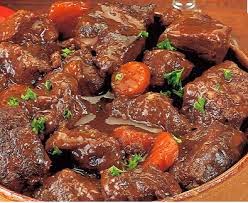
In 1688 the French Huguenots arrived, bringing their Provençal cuisine which fused with that of the Cape Dutch and enlivened it with the addition of fresh herbs and wine to their traditional casseroles. They also brought with them grape vine cuttings, from which they started the wine industry that flourishes in the Cape today.
French Provencale casserole

In the 1700's the Dutch imported slaves from their colonies in the Dutch East Indies. They came to be known as Cape Malays. Many were employed as cooks and forever altered Cape Dutch cuisine with the addition of tropical spices.
Sosaties, a Malay dish of skewered meat,
 marinated in a mixture of spices.

When the British took over the Cape Colony from the Dutch in 1815 they brought with them the British-Indian cuisine (such as "curries" and "chutneys") that they had come to enjoy during their colonization of India.

In the late 1800's the British transported indentured workers from southern India to tend the sugar-cane plantations in the Natal Colony. They brought their hot and spicy curries, using a lot of chili, coconut, tamarind, garlic and ginger. They also introduced the naan and roti breads which are first cousins to "askoek" and "pannekoek".
Curries and naan bread

Soon merchants from the northern Indian state of Gujerat migrated to Natal independently. (Among them was Mahatma Ghandi who lived in South Africa for 21 years.) With them, from the north of India, came their aromatic and complex, predominantly vegetarian cuisine.

The pioneers who trekked into the interior of the continent needed to take supplies that were light and nourishing: from them we got biltong, dry boerewors and rusks.
Dry rusks: delicious dunked in coffee!

Until the advent of the railways, “transportryers” with ox wagons took supplies to the gold fields and to the outlying districts. They perfected “potjiekos”: a slowly simmered stew of layered meat and vegetables, made in a three-legged cast iron pot over a few coals at the outspan.

All these strands make up the tapestry of our traditional cooking. Over the centuries there have been outstanding exponents of the culinary art: Miss Hildegonda Duckett, Louis Leipoldt and SJA de Villiers to name but a few.  

Miss Hildegonda Duckitt, the grande dame of Cape cooking, was a granddaughter of William Duckitt, who arrived at the Cape in 1800. She spent her early life on the farm Groote Post, baking mosbolletjies using fermented grape juice instead of yeast to make the dough rise. Her tea cakes, called oblietjies , were also a hit after she revved up an old Huguenot recipe and added cinnamon and white wine. And for children she would make tameletjies: sweets of naartjie peel and pine nuts.  For the cold farm nights on Groote Post, egg flips would be made from a bottle of Madeira, five eggs, cloves, nutmeg and the ubiquitous cinnamon.

Hilda learnt her speciality - tortoise, scalloped with breadcrumbs, butter, lemon and salt - from Abraham, a Swahili cook on the farm. The trick was to scratch the tortoise on the back until its inquisitive head popped out - and then chop it off. Tortoise, like most exotic white meat, is reported to taste like chicken.
She also had an interesting list of home remedies: here are a few from ‘Hilda’s Diary of a Cape Housekeeper’, published 1902:  

Ø  Cure for Toothache. – Mix 60 grains cocaine, 1 teaspoonful tincture of opium, and bottle.  A tiny piece of cotton-wool steeped in this and put in the cavity of the aching tooth will give instant relief.  (I bet it will!)

Ø  Overdose of Laudanum, etc. -  In case of an overdose of laudanum or opium or alcohol, immediately administer an emetic of mustard-and-water, and above all keep the patient awake and in motion, slapping him with wet towels and trotting him up and down the room till a doctor can attend.

Ø  Jaundice  -  The yellow flowers of the wild hemp, known at the Cape as “Dacha”, Cannabis sativa (the leaves of which plant used to be dried and smoked by the natives), made into a tea and taken three times a day, is most efficacious. (Now that has to be better than Rooibos!)

"No, really, Sergeant, trust me, the cocaine, the opium and the dagga are for medicinal purposes only!"
 Those were the days!!


The celebrated Afrikaans poet C Louis Leipoldt (1880-1947) wrote some fascinating and engaging cookery books. They contained not just recipes, but anecdotes and musings of this great writer who was also a bushveld doctor, medical specialist, botanist, chef and all-round epicurean.

 
SJA de Villiers is South Africa's answer to Mrs Beeton. She will always be remembered for her definitive Kook en Geniet, which first saw the light in 1951 and is to be found in the kitchen of every South African housewife. The first English edition, Cook and Enjoy It, appeared in 1961. Nearly a million copies of the two editions had been sold by the turn of the century.