Saturday, 27 July 2013

The French Connection

The Green Parasol by E. Phillips Fox
The Monet blockbuster at the NGV International has rather overshadowed the magnificent exhibition of Australian Impressionists currently showing at the Ian Potter Gallery. No long queues and jostling crowds here. They're all across the road goggling at Monet.

The exhibition is called "Australian Impressionists in France", but it should really be called "Australian and French Impressionists in France and Australia". Although predominantly Australian, the artists on show include French, British and American masters. The 120 works are sourced from various international galleries, private collections and from all the major Australian art galleries.

Ambrose Patterson
The theme of the exhibition is how expat Australian artists became part of the international community of artists who lived and worked in France from the 1880s to the beginning of the 20th century. France was the hub of the art universe, and those years changed the course of art.

E. Phillips Fox
We are told of friendships that developed: Monet dined with John Russell and they painted together; Charles Conder trawled the nightclubs with Toulouse-Lautrec, where they sketched, drank absinthe and contracted the syphilis that killed them both.

I liked the way the curator juxtaposed works with similar subjects by different painters: street scenes by Pisarro and Ambrose Patterson; nudes by E.Phillips Fox and Pierre Bonnard; seascapes by Monet and John Russell.

The paintings depict not only Parisian scenes, but find a wealth of subject matter in the countryside - no shortage of haystacks and peasants, orchards and cottages. The French countryside is very beautiful - it is the only reason I watch that bunch of drug-addled cheats on the Tour de France.

Some of my favourites in the show are by women: Jane Sutherland, Bessie Davidson and Ethel Carrick among others. I have always thought it a shame that Ethel Carrick's work is so overshadowed by that of her husband, Phillips Fox, and I agree with Grace Carroll that that says more about attitudes to women than about her artistic talent.

This marvellous exhibition is still on until 6 October 2013 - plenty of time to pay it a visit and see for yourself all the delights that I have no room to describe here.

Having spent a pleasant couple of hours at the Ian Potter with the painters, I went next door to ACMI to visit the Thespians. The Hollywood Costume exhibition is a real treat for movie fans.

I loved it all - Scarlett's green velvet curtain dress, Holly's little black number, Dorothy's blue gingham, Superman suspended from the ceiling in full flight, wearing his underpants outside his leotards as usual. That's what happens when you change in a hurry in a phone booth.

There was the Meryl Streep area: the French lieutenant's woman in her cloak, the Devil in her Prada, Lindy in her pink sundress (sans baby). There was the Queen Elizabeth area: the Flora Robson, the Bette Davis and the Cate Blanchett, each more opulent than the last. And the very best one … Hedy Lamarr's magnificent peacock dress from Samson and Delilah. Edith Head's masterpiece!

Oh, the glamour. And oh, what tiny waists all those women had!

The show closes on 18th August. Last chance to see!


Friday, 7 June 2013

One Thing Leads To Another

 
I am rather partial to a whodunnit and I always like the ones who cast a real person as the amateur detective. Stephanie Barron has Jane Austen doing a Regency era Miss Marple; Jane Laurence gets Canaletto to combine painting with sleuthing. Elliott Roosevelt sets his mysteries in the Roosevelt White House with First Lady Eleanor (the author's mother in real life) doing
the sleuthing. In Karen Harper's delightful historical detective stories, the first Queen Elizabeth solves the mysteries, and I have even read a short story by Peter Lovesey where Princess Diana and Sarah Ferguson team up to solve the mystery of Glamis Castle. Groucho Marx, Conan Doyle, Oscar Wilde, Bette Davis … any number of real characters have done some fictional sleuthing!

So I was delighted when a friend recommended Nicola Upson, whose  detective novels set in the 1930s feature Josephine Tey as the amateur sleuth. The first one I read, was Fear in the Sunlight: Miss Tey finds herself in the picturesque Welsh coastal village of Portmeirion, among a bunch of Hollywood stars, film crew and assorted celebrities. Among the hotel guests are Alfred Hitchcock and his wife Alma, who make Miss Tey an offer for the film rights to her book A Shilling for Candles.

Two rather gruesome murders are committed and after some suitably Hitchcockian twists and turns of the plot, elegantly solved. Miss Tey sells A Shilling for Candles to Hitchcock despite her misgivings that her book will be butchered by the Hollywood scriptwriters. In an epilogue Josephine tells a friend that Hitchcock based his film Young and Innocent on it. And yes, as she suspected, the plot and characters took a battering.


I enjoyed Fear in the Sunlight, and it led to my looking up the fascinating history of Portmeirion, which didn't just grow like other villages: it was designed in 1925 and built by Sir Clough Williams-Ellis in the style of an Italian village. It is now owned by a charitable trust. In the 20s and 30s it was a very fashionable resort, patronised by the Bright Young Things and by celebrities who had actually accomplished something for which to be celebrated. Noel Coward wrote Blithe Spirit there.
I also rummaged among my old books to find the yellowing copy of A Shilling for Candles, in which I was  amused to see my name on the flyleaf in a schoolgirly hand. How embarrassing - I used purple ink in my fountain pen. Oh, well, I was a teenager and heavily into Marie Corelli at the time. A Shilling for Candles is still an intriguing mystery, if a bit dated … everybody smokes and wears hats!

After reading that, I had to get the DVD of Young and Innocent out of the library, just to see how Alfred Hitchcock sliced and diced the book. Vintage early Hitchcock … his hallmark plot of innocent man on the run with his girlfriend, while trying to discover the real criminal. Sound familiar? Yes, we've all seen The 39 Steps, North by Northwest and The Wrong Man! This one is a bit of an underrated gem, and worth a look. Lots of suspense and a few splendidly Hitchcockian sequences, like an elaborate crane shot near the end, quite groundbreaking for its time. I nearly missed the Hitchcock cameo, but spotted him after all, standing outside the courthouse with a camera.
Josephine Tey
Now that I have exhausted all the side tracks that Fear in the Sunlight led to, I'm ready for my next Nicola Upson!
 

Friday, 24 May 2013

Turner From The Tate

I flew to Adelaide to catch the last weekend of the Turner exhibition - it was well worth the effort and I highly recommend it to our members. To late for Lovely Adelaide now, you'll have to go to Freezing Canberra and run the risk of seeing a politician in its natural habitat. Hang a clove of garlic round your neck just in case.
Scarborough Town and Castle:
Morning, Boys Catching Crabs

Before setting off for Our Nation's Capital, I suggest you borrow the DVD Simon Schama's Power of Art, which is available at all branches of the Nunawading, Monash and Eastern Region library services. The episode about Turner gives a special perception into the painter's bizarre private life, the psychological and emotional pressures that shaped his art and the way he worked. Viewing the exhibition, the experience was enhanced for me by the insight I gained from Simon Schama's interpretation.
The Wrecked Female Convict Ship Amphitrite:
Women and Children Abandoned in a Gale

Schama highlighted the dramatic picture The Slave Ship, which he considers Turner's masterpiece. Sadly, this highly charged emotional work was not included in the exhibition, but we did see Disaster At Sea, (alias The Wrecked Female Convict Ship Amphitrite: Women and Children Abandoned in a Gale) which is perhaps more appropriate for Australia, depicting as it does the shipwreck off the French coast of a convict ship bound for Botany Bay, with 150 women and children on board. When the ship foundered, the French offered to evacuate the passengers, but the captain refused, saying his orders were to take them to Australia and he is not allowing them to set foot in France. Only three survived, the episode causing a huge scandal at the time. Turner poured a lot of rage and frustration into the huge painting, emotions that fairly boil off the canvas and stops the viewer in their tracks.  

Burial At Sea
 
I would have loved to see The Fighting Temeraire, but that was perhaps too much to hope for! The Tate wasn't going to take any chances with their number one attraction. As it is, the 100 works in this exhibition were flown out to Australia in small batches and in secrecy.  Failing The Fighting Temeraire, we saw Burial At Sea, which also juxtaposes steam and sail, with similar lighting effects of sky, sun and sea - the trademark Turner Effect.
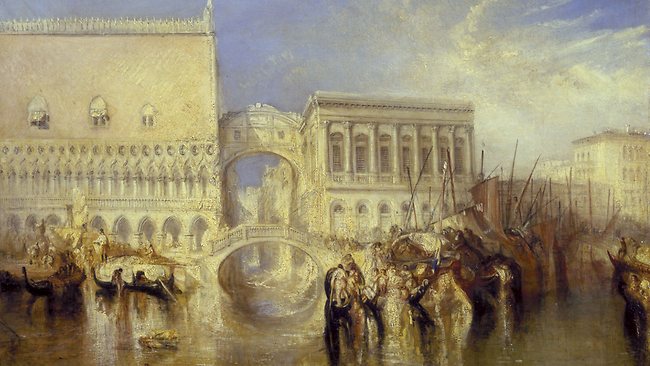
Venice: the Bridge of Sighs

Turner's powerful seascapes full of brilliant light and dramatic skies always spring to mind when his name is mentioned, but this collection also contains some wonderful landscapes, painted in London and Wales, in Venice, in Rome and in the Swiss Alps.
Venice by Moonlight

Unconventional as Turner was for his time, he also painted some of the "classic" scenes that were approved by the Establishment: I liked Rome, From The Vatican, Raffaele, Accompanied By La Fornarina, Preparing His Pictures For The Decoration Of The Loggia (Yes, it is all one title! He needed a ruthless Title Editor). 
Rome, From The Vatican, Raffaele,
Accompanied By La Fornarina, Preparing
His Pictures For The Decoration Of The Loggia

Dido Building Carthage reminded me so much of Claud Lorrain's Embarkation of the Queen of Sheba, that I Googled it when I got home. All great artists influence each other. Turner was clearly an admirer of Claud's work: see for yourself!
Dido Building Carthage by JWM Turner

Included in the exhibition are works held in various Australian galleries: one of my favourites is Scarborough Town And Castle, Morning: Boys Catching Crabs which belongs to the Art Gallery of SA. (See picture near the top of the page

The Embarkation of the Queen of Sheba by Claud Lorrain

Tuesday, 26 March 2013

Judging A Book By Its Cover Again.

It's time again for my favourite literary award of the year! You can keep your Pulitzers, your Bookers and your Miles Franklins: the Diagram Prize, for the year’s oddest book title, is the one I await with bated breath.

And this year the Diagram goes to … taa-raaaah! Goblinproofing One’s Chicken Coop!  Intriguingly subtitled: … and Other Practical Advice in Our Campaign Against the Fairy Kingdom. According to the The Bookseller magazine, the author, Reginald Bakeley, believes the prize "is a clear sign that people have had enough of goblins in their chicken coops." He added, "Our Campaign against the fairy kingdom continues." No doubt those of our members who keep chooks in the backyard, will be queueing up at Dymocks for their copy. 

At the same time they may want to buy The Art of Faking Exhibition Poultry:  a very useful read for  anyone who wants to know the techniques for faking leg colour, dyeing and bleaching plumage or inserting extra feathers. The knowledge might even be applied to the reader herself, thus saving the expense of a trip to the beauty salon.

The Book Depository ran a special this week on the books that were shortlisted for the Diagram Prize, and I have to say I was tempted by some of them.

As an inveterate tea drinker who despises the teabag-in-a-mug method and always uses a teapot, I would like to read How Tea Cosies Changed the World by Loani Prior. This is a sequel to Really Wild Tea Cosies. Who knew there was a secret life of tea cosies?

Then there are a few self-help manuals that might be useful: How to Tell If Your Cat is Plotting to Kill You, How to Sharpen Pencils, and How to Tell If Your Boyfriend is the Antichrist. I for one feel safer knowing these are available in my local bookshop should the need arise.

Vulgarity alert! Here I have to insert a warning that some of my Gentle Readers might find the next four volumes under discussion offensive: if you are reading this aloud to a refined audience, better skip the next few paragraphs.

How to Shit in the Woods by Kathleen Meyer is a useful handbook for backpackers, hikers and campers. The blurb says it is essential and vastly entertaining reading for anyone who has ever found themselves in the wilderness without loo paper or a portable commode. What?! Who goes mountaineering without a portable commode? It's the first thing I pack.

Who Cut the Cheese? is another one for the scatologically-minded among us. To quote from the Book Depository website, "Jim Dawson sniffs out a load of historical and scientific fart tales, then offers the kind of fun facts you'll be dying to let slip at social occasions, in chapters like "Fart Facts That Aren't Just Hot Air" and "Gone with the Wind" (on famous movie farts). From fact to fiction to frivolous flatulence, this book is unquestionably a ripping good read."

How to Pee Standing Up is written by the rather disturbingly surnamed Anna Kevorkian and illustrated by Sara Schwartz. Do we really want illustrations? Those of us who have seen The Paperboy have already seen Nicole Kidman demonstrate the technique by peeing on Zac Efron after he got stung by jellyfish. Enough, already!

Still in micturating mode, we have Life of Pee, by Sally Magnusson. The blurb says: "Alchemists sought gold in it. David Bowie refrigerated it to ward off evil. In the trenches of Ypres soldiers used it as a gas mask, whereas modern-day terrorists add it to home-made explosives. All the Fullers, Tuckers and Walkers in the phonebook owe their names to it, and in 1969 four bags full of it were left on the surface of the moon." It actually sounds quite interesting and I might get the library to buy it!

Across Europe by Kangaroo is the story of an American family's odyssey - I suppose the title just means they called their hired van "Kangaroo", but I prefer to think of them bounding along the autobahns a-kangarooback, clinging on for dear life, with their luggage stuffed into the pouch. (Including a portable commode, just in case.)

When I hear the words "duct tape", I find that white vans, boxcutters and serial killers spring to mind. In every gory thriller and TV crime show, the miscreants rely heavily on duct tape and they always have a white van. Here we have a craft project book called Ductigami, by  Joe Wilson. Apparently you can make all sorts of useful items, from mobile phone holders to shower curtains, using only a roll of duct tape and a box cutter. All you need now is a white van and you can go into the kidnapping business. 

Flattened Fauna  is Roger M Knutsen's field guide to roadkill … very helpful for those of us who prefer to observe wildlife en passant, as it were. I imagine this book is to roadkill what Identifying the Birds of Australia is to ornithology.

Crafting with Cat Hair and Tea Bag Folding are two books no handicraft hobbyist should be without, and for the keen motorist, The Driver's Guide to Hitting Pedestrians will be the ideal Christmas gift.

For animal lovers, there are two companion volumes by Patty Brown: Is Your Cat Gay? and Is your Dog Gay? Among the "tell-tail" habits of the gay dog are: accepting doggy-bags only from five-star restaurants and obsessive grooming. It all seems rather intrusive. Where's the dog's right to privacy? I shouldn't think you really need to know if your dog is gay. Unless, of course, you fear that your dog is turning into a real bitch.

Finally, two very useful little books, consisting of postcard-size pictures of dear cuddly baby animals, each with a message. If you have to break bad news or answer awkward questions, let a ducky or kitty do it for you - that might soften the blow. Simply cut out the appropriate page and hand it over or better still, post it. The books are respectively titled Grandma's Dead: breaking Bad News with Baby Animals, and Why Is Daddy in a Dress?: asking Awkward Questions with Baby Animals. Very handy if you have to tell a child there is no Santa Claus or inform your married boyfriend that he is the father.

I feel the Diagram Prize Jury has done very well by us this year, and I am looking forward to next year's crop of The Oddest Titles!

Thursday, 7 February 2013

Easter Eggs


This April it is appropriate to talk about Easter Eggs - those delightful little surprises that the Easter Bunny hides in unlikely places, for us to find. They are not always chocolate eggs either: they hide in paintings, movies, books and in your computer!

Google is particularly fond of hiding an easter egg to amuse the user who finds it. If you ask Google to define anagram, you get one! The list of results is headed by the message: Did you mean nag a ram?

Type into the Google search box Let It Snow , click "I'm Feeling Lucky"… and it does! If you type Google Gravity and click "I'm Feeling Lucky", Google succumbs to gravity and everything on the screen collapses and falls to the bottom.

Ask Google what is the answer to Life, the Universe and Everything, and it will tell you it is 42. OK, so it got the answer from The Hitchhiker's Guide to the Galaxy, but still … Google knows 'the number of horns on a unicorn', and it knows 'what is the loneliest number'. Just ask!

Seinfeld fans will know that George Costanza's father invented a secular festival to replace Christmas: it is called Festivus, and the proceedings include The Airing of Grievances (so how is that different from Christmas?) and instead of a Christmas Tree, there is the Festivus Pole. If you type festivus into the Google search box, the Festivus Pole appears in the left margin.  Clearly the Google Guys watch a lot of Seinfeld.

As if you don't already waste enough time online, Google can surprise you with little games: If you type zerg rush into the search box and just click the normal search button,  the red and yellow letters O from the Google logo come out of the margins and start wiping the screen clean. You can shoot them down by clicking your mouse on each one until it dies. When they have all reached the bottom of the screen, the game is over, they form the letters GG for Good Game and you get your score.

One of my favourite Google surprise time wasters is the Six Degrees of Kevin Bacon game. You know how that goes: every movie actor can be connected to Kevin Bacon in no more than six steps - for example, Marilyn Monroe's Bacon number is 2: Marilyn Monroe and Eli Wallach appeared in Making the Misfits;  Eli Wallach and Kevin Bacon appeared in Mystic River. Voila. Type any actor's name into the search box followed by the words bacon number, and see if you can find one that needs more than six steps to Kevin. I couldn't find one higher than three, and for that I had to go back to Leni Riefenstahl! Even Al Jolson is a two.

If you are using Mozilla Firefox or Chrome as your browser, type do a barrel roll into the Google search box, and the screen rotates through 360º. It doesn't work so well in Internet Explorer.

Wikipedia has one of my favourite Easter Eggs: if you type easter eggs (media) into the search box, you will get an article about easter eggs in the media, and the picture at the top right shows two bunnies and a hedgehog. Click on the hedgehog, the screen goes blank and a big basket of colourful easter eggs appear!

In the movies, Alfred Hitchcock is not only the Master of Suspense, but the ulimate Master of the Easter Egg, with his cameo appearances. He is even shaped like an easter egg!

His ingenuity was taxed in movies like Lifeboat, Rope and Dial M for Murder, where the action was confined to an apartment or indeed a lifeboat - no crowd of extras where he could hide. In Lifeboat, he appears in a newspaper ad for a slimming product, in Dial M for Murder, he is in a group photo on the wall; in Rope, we have to look through the window to see his portly outline in a red neon sign on another building.
Picasso's portrait of Gertrude Stein
Woody Allen hid a whole lot of easter eggs in his 2011 hit movie, Midnight in Paris. Picasso's portrait of Gertrude Stein, Toulouse Lautrec's Moulin Rouge posters, Dali's rhinos … any number of famous artworks are casually scattered here and there as part of the set. Among the characters we recognize Cole Porter tinkling away at a piano ("Let's Do It"), Scott and Zelda Fitzgerald doing the Charleston and a man trying to sell some paintings for a pittance. When you get a look at the paintings, you realise it is Matisse!

Corey Stoll plays Ernest Hemingway, and a lot of his lines come straight out of Hemingway's books. I suppose each viewer only picks up the hidden allusions that are familiar to him or her. I wonder how many easter eggs that I missed are hidden in that film!

All the biopics about artists are hotbeds of easter eggs. (Or hotnests?) Kirk Douglas paints his Vincents in Lust for Life; Charlton Heston beavers away at the statue of Moses in The Agony and the Ecstasy, but I suppose those don't strictly qualify as easter eggs, because they are not hidden.

Love is the Devil, the biopic about Francis Bacon, has many easter eggs in the form of scenes that are staged to look like his paintings, and will only be recognized by those who have seen the particular pictures.

In his bedroom is one of those old-fashioned dressing tables with the three mirrors. As Bacon's lover, George Dyer (played by Daniel Craig before he got his 007 badge) preens before the angled mirrors, we see the famous triptychs Bacon painted of him. 

Easter eggs in literature are easy to miss - an author's sly allusion to a current person or situation has a limited shelf life, unless it is about such a cause célèbre that it still resonates in the zeitgeist when the book is read years later.

M.J.Trow hides many delightful easter eggs in his novels, especially those Victorian detective stories featuring Inspector Lestrade. (Yes, he has hijacked  the Lestrade of Sherlock Holmes fame, brainchild of Conan Doyle.)  To quote only a couple:

"Beautiful car!" … "Yes, it's a Lanchester. I call her Elsa."

"Constable Marks! Make some tea, please. And send Spencer out for a packet of digestive biscuits."

I once read a forgettable whodunit (can't remember the author or title now, which just shows you) but I laughed out loud when the pathologist said: "I'll see you at the autopsy, Inspector. You know where the morgue is? 13 Miller's Court."  Now there's an easter egg par excellence! Look it up,  easter eggs are much more fun when you find them yourself.

Lots of artists put easter eggs into their paintings. Terence Cuneo, the famous railways painter, always hid a little mouse in his paintings. He was the official painter for Queen Elizabeth II's coronation in 1952. There is a statue of him in the concourse of Waterloo Station in London, and a little mouse peeps out from under the painterly paraphernalia at the statue's feet.

Whistler liked to put a butterfly in his paintings. It evolved from his initials, JW. At the time of his bitter feud with Ruskin, he put a sting in its tail, and in the year of his marriage he added a clover to it for luck.

When the ceiling of the Sistine Chapel was cleaned in recent years, the workmen on the scaffolding got close enough to see tiny cherubs making rude gestures - Michelangelo hid his irreverent little jokes by making them too small to be seen from the floor below.

The depiction of God and Adam on the Sistine Chapel ceiling is the most recognizable piece of Western art after the Mona Lisa. An article in The Journal of the American Medical Association opines that the figures and shapes portrayed behind the figure of God appear to form an anatomically precise picture of the human brain. Michelangelo's accurate anatomical knowledge due to his covert dissection of dead bodies is well known, so this may indeed be true. If so, it is an easter egg with a time delay: it had to wait for the publication of Gray's Anatomy to be recognised.


The Arnolfini Portrait - look at the mirror.
Some painters like to hide a self-portrait among the other figures in a painting: Velasquez in Las Meninas; Jan van Eyck in The Arnolfini Portrait; Frans Hals in the group portrait of the Civic Guard of St George, and Tiepolo in our very own Cleopatra's Banquet in the NGV, come to mind. There will be many others.
Van Eyck's selfportrait in the mirror

Hans Holbein loved an easter egg: the mottled, elongated oval that becomes a skull if you look at it sideways in the foreground of The Ambassadors, not to mention all the arcane items on the shelves between the two figures, that practically illustrate their whole biographies, for those who know what they mean.

I also like Holbein's Lady With a Squirrel and Starling. The sitter is Lady Anne Lovell. The Lovell family crest contains three squirrels, no hidden surprise there.

The easter egg is the starling: the family's manor house is in East Harling, which was commonly spelt "Estarling".

Gargoyles are part of the gutter system of a building - they spout water. Grotesques are small, bizarre sculptures lurking high up on the eaves and towers. The National Cathedral in Washington DC is adorned with 112 fearsome gargoyles, and dozens of grotesques, the most famous of which is Darth Vader.

Star Wars? Not very ecclesiastical, you say? On the contrary: in the 2011 census, over 70,000 Australians declared their religion to be Jedi.

May the Force be with you!