Tuesday, 4 February 2014

The World of L.S. Lowry


Caroline went to Salford: this is what she saw there.
L.S.Lowry: Self-portrait
Think of Manchester, and you think of football, and factories. In fact, there is a thriving arts and cultural scene in Manchester, and echoing a global trend in docklands redevelopment there has been the recent construction of a major arts and entertainment complex in Salford Quays.
The complex, located in an area long considered one of the bleakest in Manchester, has been named the Lowry Centre, after one of Salford’s favourite sons, the artist Laurence Stephen (LS) Lowry. As well as theatres, concert halls and restaurants, the Lowry Centre Art Gallery is home to an excellent collection of local and contemporary art including a comprehensive permanent collection of paintings by LS Lowry.
To be honest, I hadn’t heard of Lowry until moving to Manchester, where he is very well known as one of their most famous local artists. My friend Gordon had been a fan of his work for some time, and when he came up north to visit me, he insisted we take a trip to the Lowry Gallery.
 
“Matchstick men!” Gordon kept singing from the back of the minicab all the way to Salford Quays, “...and matchstick cats and dogs!”  – this had been a hit song by the duo Brian Burke and Michael Colman, commemorating the style of LS Lowry after his death in the late 1970s.
Life in Salford: football and factories 
Lowry was born in 1887 and was a prolific painter of life in Salford all his adult life.  Lowry’s interest in the urban and industrial landscape captured something quite unique. His signature “matchstick men” (marching to work in the factory, or gathered at the football ground) are indeed simplistic but in their sheer numbers make up a crowd heaving with life and movement.
One of his most famous paintings, Going to The Match, sold for 1.9 million pounds.
Going To The Match
What I found quite amazing was the way in which Lowry’s paintings of crowds or busy streets appear to give you a distance and vantage point that Lowry could never have had except for in his imagination.
Lowry’s father had emigrated from Ireland, and as a young man, Lowry worked as a clerk with a firm of accountants while attending the Municipal College of Art. He lived with his parents, and was to continue doing so for nearly forty years until the death of his mother.
 
Despite painting in Manchester almost exclusively, Lowry was a much celebrated British artist during his lifetime and received numerous honours (including election to the Royal Academy) for his contribution to recording of life in the industrial northwest of England. 
Lowry’s work is incredibly evocative of working class life in the industrial northwest, and the Lowry Centre Gallery strives to show this, with big windows all through the complex that look out onto chimneystacks and grey brick buildings that inevitably mirror an equally grey sky. All around you is Lowryland.

Although best known for Salford scenes of life and labour under dreary skies, I was also impressed by Lowry’s portraiture. He painted his subjects with a warmth that is obvious. There are many portraits that feature the recognisable face of a certain woman. As Lowry was never married, her identity is something of mystery – some suggest she was his mother (there have also been suggestions of an Oedipal obsession). Others suggest she was Carol-Ann Lowry, a girl who had written to him, excited when she found out she shared a name with a famous artist. They remained friends for years, and when Lowry died, he left his estate to her.
 
One of the paintings I liked the most was one called “The Bedroom”, painted at the his parents’ house where Lowry lived almost all his life, and for much of that with his bed ridden mother. The painting reminds me so much of that famous painting of Van Gogh’s bedroom in Arles. The surroundings are simple, functional, sufficient – the unadorned surroundings of a man who lived alone after his mother’s death and dedicated himself to his art.
In retrospect, the work of LS Lowry is a record of the end of the industrial revolution in Britain, as well as a record of the living spirit of Manchester: factories, and football and a rich cultural life.
The Lowry Centre is well worth a visit, and you can read more about it as well as more about the life of LS Lowry here http://www.thelowry.com/  


Friday, 24 January 2014

Miss Charlotte, In the Bathroom, With a Knife.

Charlotte Corday


The Death of Marat: Jean Louis David

I am a bit of a Jean Louis David fan, so I was excited to read that two of his greatest works would be on display at the NGV during the Napoleon exhibition: Napoleon Crossing the Alps and The Death of Marat. The life-size Napoleon on his white charger was everything I expected, but I was sadly disappointed to discover that The Death Of Marat was a copy, and quite a small one at that. The real McCoy is six feet by four and lives in the Fine Arts Museum in Brussels.

It is a powerful painting, with a high emotional impact, as David indeed intended it to be. David might be the first political spin doctor - he certainly pulled off a tour de force of manipulating public opinion with this one. Here's how he came to paint it:

The French Revolution was in full swing: guillotine operators doing double shifts, Madame Defarge busily knitting culottes for the Sans-Culottes, the Scarlet Pimpernel flat out smuggling aristos to safety, Marie Antoinette promoting her Cake Diet.

In the legislative assembly, the deputies belonged to different political parties, just as they do in our very own Parliament today. On the one hand you had your extreme radical, off-with-their-heads republicans, known as the Jacobins.  And in the opposite corner, the Girondists: a more moderate faction who, while still backing the Republic, tried to apply the brakes to the frenzy and wholesale slaughter of the Reign of Terror.

Jean-Paul Marat, a deputy to the Convention and a firebrand journalist, was one of the most radical voices of the Jacobins and directly responsible for the denunciation and execution of many people, prominent Girondists among them.

Twenty-five-year-old Charlotte Corday, member of a minor aristocratic family and ardent Girondist sympathiser, decided that if Marat were not there to incite the mobs to more violence, the Girondist policy of moderation might prevail. It seemed like a good idea to travel to Paris and save her country by killing Marat.  She could see the headlines already: "Brave Damsel Slays Wicked Tyrant - Saves France!"

Like Baldrick in Blackadder, Charlotte devised a Cunning Plan. She would approach Marat in the guise of an admirer who wanted to give him a list of Girondist plotters, fodder for the guillotine. Stopping only to pack a spare set of undies and the cook's best filleting knife, she set off for Paris.

Marat was not at the Chamber of Deputies, where she went first. He was working from home (so that's not a new concept, either!) so that he could immerse himself in a bath of medicinal herbs to soothe the nasty, itchy, suppurating skin disease that covered his body from scalp to toes. Not a pretty sight, and smelly to boot. He had tied a grubby wet rag round his head and was using a plank across the bath as a desk.

Charlotte's plan worked - after being turned away once, she was allowed in to see him on her second try. She told her story, handed over her list of names, and as he took it, she whipped  out the knife and stabbed him in the heart. She made no attempt to flee, but waited to be arrested. All part of the plan: she would be seen as the lovely young martyr, sacrificing herself to rid France of the tyrant.
It all backfired big-time. 150 years before Goebbels even invented the word propaganda, the Jacobins pulled off the biggest propaganda event of the Revolution. It was Marat, not Charlotte, who was the martyr, he who received a hero's funeral while she was ignominiously guillotined four days later. 

She was jeered all the way to the scaffold.  Her thick chestnut curls were roughly cut off close to her head because the only thing capable of slowing the guillotine blade was human hair. As her head fell into the basket, a young assistant (I imagine an overexcited teenager doing work experience) grabbed it by the hair, brandished it to the crowd and slapped both cheeks. This was considered going a bit too far: he was reprimanded and dismissed. Charlotte Corday's remains were unceremoniously tossed into an open, pestilent, public grave, among those of the other guillotine victims.
Marat was buried in the Pantheon
Jean-Paul Marat, hero/martyr, was buried at the Pantheon, after his coffin was paraded through streets lined by weeping citizens, throwing flowers. (Sadly, Elton John would not be born for two centuries.)


The very day after the murder, David, himself a friend of Marat and a committed Jacobin,  was commissioned by the Convention to paint Marat's portrait. He accepted with enthusiasm, and set about the creation of this idealised image.
The Death of Marat: Jean Louis David
Due to the unsightly skin disease and rapid decomposition, there was no question of painting the actual scene. He painted Marat dying: eyelids drooping, his head leaning on his shoulder, his right arm hanging down. This instant between the last breath and death had an immense impact at the time, and is still effective today.

Marat's flawless body is that of a young, healthy man. The knife is not where Charlotte left it, gruesomely sticking out of his chest, but lying next to the bath. The grubby rag has been transformed into a pristine turban.

The picture is dramatic and poignant; the viewer feels compassion and outrage. David deliberately referenced classic religious art, depicting Marat as a secular martyr. The bloody gash echoes Christ's stigmata and the hanging arm and inclined head has often been compared to Michelangelo's Pieta.

Indeed, the whole pose resonates with the many depictions of Christ's Descent from the Cross: Rembrandt, Rubens, Van der Weyden … Marat recalls them all. David uses Caravaggio's "cinematic" lighting for dramatic effect: spotlight on the body against a dark background.

Winston Churchill was an admirer of Charlotte Corday and kept a reproduction of her portrait on his wall. He said it was a great help when dealing with Charles de Gaulle: he could point out what happened to arrogant Frenchmen who did not mend their ways.


Tuesday, 21 January 2014

Séraphine de Senlis


Perhaps Séraphine Louis' parents had a premonition when they named her after the first rank of angels in the Heavenly Choir, the Seraphim. The paintings of this remarkable artist were inspired by an almost medieval religious passion that wavered between between ecstasy and psychosis.

Her extraordinary and tragic life is movingly portrayed in the film Séraphine, which won seven Césars, (the French version of Oscar) in 2009, including Best Film, and Best Actress for Yolande Moreau who played Séraphine . It is available on DVD at your local library: see it!

Orphaned as a toddler, Séraphine  was brought up by her older sister Victorine, who did domestic work and field labour on a farm. She was a solitary child and preferred walking alone in the woods to playing with the other girls. She was fascinated by nature's beauty and spent a lot of time studying the plants, bird life and insects in the woods and fields.

At 13, Séraphine  started full-time domestic work. She worked for 20 years at the convent of the Sisters of Charity in Clermont, becoming more and more enraptured by the colours of the stained glass, the smell of wax and incense, the singing and the praying. She believed she saw an angel, commanding her in the name of the Virgin to paint pictures for the Glory of God.

She left the convent to work as a char in the village of Senlis. The townsfolk regaded her as the Village Eccentric: talking to herself, muttering prayers and fossicking about in the fields for the plants and natural substances which she mixed with Ripolin housepaint for her artwork. Her mystic "secret recipe" contained earth, moss, blood, holy oil, and who knew what else: she would never disclose what went into it or what prayers and incantations were involved.

At the end of her arduous day of drudge work, she would paint by candelight in her garret: minutely detailed compositions of fruit, plants and flowers, in glowing colours reminiscent of the illuminations  by medieval monks. From time to time she would give a painting to one of her employers, and this is how her work was discovered in 1912 by the German art collector, critic and dealer Wilhelm Uhde.

Uhde, who had rented a weekend apartment in Senlis for a bit of respite from the rat race in Paris, saw an exquisite small picture of apples in the dining room at a neighbour's house, and was amazed when told that his own charwoman had painted it.

Uhde helped Séraphine  with advice and money, and she was able to start using larger canvases instead of the small wooden boards she had been scrounging. His support had barely begun to expand her horizons, when the outbreak of WW1 in 1918 forced him to return to Germany, leaving Séraphine  rudderless.

She survived the war in wretched poverty. Her eccentricities became worse, nobody would employ her and she was reduced to begging, helped a bit by selling the occasional painting. Her mental deterioration was reflected in her work, tentacles and eyes sprouting from the fruit and flowers.

In 1927 Uhde, now back in France, saw three of her paintings in a local art exhibition in Senlis. He described them in his diary: "three large canvasses of startling power: a bouquet of lilacs in a black vase, a cherry tree, two laden vinestocks, of black grapes and white."

Uhde bought all of them and sent them to Paris, where she was recognised as the naïve painter of the day and her work much sought after. For the first time in her life she had money to spend on canvases, stretchers, paints and varnishes. Tragically, her paranoia became worse, she barricaded herself into her home and painted frantically.

In 1930, when the art market collapsed in the wake of the Great Depression. Uhde withdrew his support and Séraphine, unable to sell anything, descended once again into abject poverty. Tragically, her mystical visions and voices became an unbearable cacophony and her mental health deteriorated to a point where she had  to be committed to the Clermont Lunatic Asylum where she died, ravaged by breast cancer. 

There is no monument to this tragic and talented woman: Séraphine  de Senlis is buried in a common grave.


Sunday, 10 November 2013

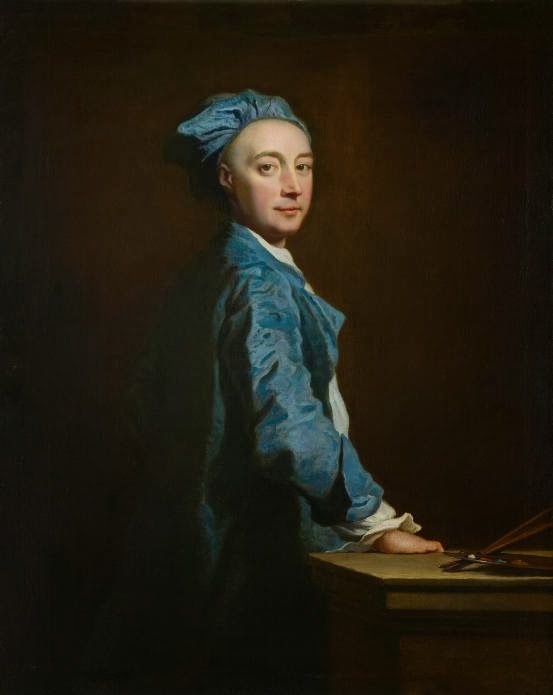
Joseph Highmore

Self-portrait: Joseph Highmore (detail)
We who live in Melbourne are very fortunate to have on our doorstep the NGV's wonderful collection of portraits, thanks to the bequest of a substantial amount of money by Everard Studley Miller in 1956. That money has now all been spent, but it enabled the NGV over several decades to purchase "portraits of persons of merit in history, painted, sculpted or engraved by 1800", according to the wish of the donor.

The portrait collection includes works by such household names as Van Dyck, Gainsborough and Reynolds, but one of my favourites is Joseph Highmore (1692 – 1780), who is perhaps lesser known today that those luminaries.
Self-portrait: Joseph Highmore

His parents disapproved of his artistic leanings and insisted that he become a solicitor, but at the age of 17, he forsook the law and for the next 50 years he devoted himself to painting.  In 1762, Highmore abandoned painting, retired to Canterbury, and took up writing. He published articles on a variety of subjects, including religion, law and art. He died in 1780 at 88 years of age.

In his heyday Highmore was a highly acclaimed portraitist.  He is reputed to have captured the face of his subject in a single sitting, never retouching it at a later date. He depicted the texture and colour of fabrics with the precision of a Van Dyck, whose work, together with that of Rubens,  he studied when he spent two years in the Low Countries. 


Samuel Booth, Messenger
of the Order of the Bath

In 1725, he was selected to paint the knights of the Order of the Bath in full costume. He was also commissioned to paint Royal portraits, which highlights his high standing among English portraitists.

In addition to his more formal portraits, Highmore also excelled at "conversation pieces", or small informal group portraits, in the manner of Hogarth, although his work is less boisterous and satirical and more refined than Hogarth's.
Mr B finds Pamela writing

In 1744 he painted a series of 12 "conversation piece" illustrations for Samuel Richardson's novel Pamela, the runaway bestseller of its day. Pamela was the first epistolatory novel: a novel written as a series of letters and diary entries, a form which became very popular.

The heroine, Pamela Andrews, is a maid whose master (referred to only as Mr B.) makes unwanted advances towards her. She rejects him until he shows his sincerity by proposing a fair marriage to her. In the second part of the novel, Pamela attempts to accommodate herself to upper-class society and to build a successful relationship with her husband.

The NGV has eight pictures by Joseph Highmore in the collection: the one I like best, is a self-portrait showing Highmore as a professional artist – he is dressed in a blue robe, with a turban taking the place of the wig he would wear on more formal occasions. Through the dramatic lighting he concentrates our attention on his face and the composition leads the eye to his tools of trade, the loaded palette and brushes.
Miss Susanna Highmore

Facing this portrait, is a delightful study of his daughter Susanna, holding a miniature of herself. There is also a portrait of his son Anthony, in the rich red velvet and gold brocade.
Anthony Highmore

In Adelaide I saw a family group by Joseph Highmore at the Art Gallery of SA – his wife Susanna, with the two children. A number of Highmore's works were brought to Australia by a direct descendant of the artist. The NGV acquired most of them – I can't think why they let the family group slip through their fingers.
The artist's wife Susanna, with her
son Anthony and daughter Susanna.
(Art Gallery of South Australia)

However, we mustn't begrudge Adelaide their one Highmore: just in the next room, we have Samuel Booth, Messenger of the Order of the Bath, resplendent in his official robes. The three-quarter length pose is typical of Highmore. The figure looks down at the viewer from a commanding position. The large white wig  was de rigueur for  gentlemen of the era.


The NGV also holds four of the "Pamela" illustrations: Pamela Fainting, Pamela greets her father, Pamela and Mrs Davers and Pamela preparing to go home. The other eight in the series are held in The Tate in London and in the Fitzwilliam Museum in Cambridge.


Monday, 28 October 2013

Fear and Loathing

Vanitas by Pieter Claeszoon

Having recently enjoyed the Monet exhibition at the NGV and the Australian Impressionists at the Ian Potter, we have had a surfeit of beauty and it is time we balanced it with a dose of the macabre, the chilling and the disturbing. And I don't mean those Renaissance martyrs who piously cast their eyes upward and maintain a saintly smile while they are being neatly and bloodlessly grilled over an open fire, pierced with a dozen arrows or having their eyes plucked out. No, I'm talking Goya, Picasso, Rembrandt, Caravaggio, Gleeson: those masters of raw violence and searing agony, lurid images that fascinate as they repel.
A Grotesque Old Woman
by Quinten Massys

Starting on a satirical note, let's look at A Grotesque Old Woman by Quinten Massys. He painted this in 1525 and clearly nothing much has changed in the last 500 years: women still delude themselves that they can dress a chewy mutton chop as a spring lamb cutlet. Massys' old woman didn't have collagen and botox at her disposal, but she gave it her best shot with rich jewels, a fashionable hat and a really disturbing, wrinkly decolletage. Her futile vanity is only emphasized by the huge ears, the wrinkles and the simian features.
Saturn Devouring His Son
by Francisco Goya

Much more macabre is Goya's Saturn Devouring His Son, one of the fourteen "black paintings" that he did in oils, directly onto the walls of the dining and sitting rooms of his house. The plaster was later transferred to canvas and they are now in the Prado. Very frail. After the ravages of the Napoleonic wars, the internal bloody strife in Spain, and his own brushes with death, Goya was depressed, disillusioned and very much aware of his mortality. All of the "black paintings" are intense and haunting, "Saturn" perhaps most of all. It depicts the myth of the Titan Saturn who devoured all his children at birth, because there was a prophesy that one of them would overthrow him. Goya might have meant it as an allegory for the way the turmoil in its own body politic was destroying Spain.
Guernica by Picasso

The horrors of war is a fertile field of inspiration for fearsome and powerful works by great artists: Picasso's harrowing masterpiece, Guernica, shows the tragedy of war and the suffering it inflicts upon innocent civilians. It is a powerful and emotional work, and has deservedly gained a monumental status as an anti-war symbol, a perpetual reminder of the tragedies of war. 
The Sower
by James Gleeson

During the 1940s, James Gleeson's work was imbued with images of war and violence. "The Sower" (1944) and "The Citadel" (1945) are fear and loathing personified. The former is a nightmare of distorted body parts, dragon heads, skulls and jagged, toothlike rocks: flesh, scales and rock are all rendered in tones of brown and grey and seem to be of the same substance. I am reminded of the Greek myth of the fierce, cruel warriors who sprang from the earth when dragons' teeth were sown. I imagine that Gleeson's title must refer to the prophet Hosea's strictures on the Israelites' warring with the neighbours: "For they have sown the wind, and they shall reap the whirlwind." Nothing much has changed in 2000 years, then.
The Citadel
by James Gleeson

Apocalyptic as "The Sower" is, "The Citadel" is more fearsome. The lurid images of mutilated body parts and an eye rimmed with teeth exert a hideous fascination. Rotten teeth chew on an arm, intestines are draped over mounds of cancerous flesh and horrid spiky plants grow at the base, like Triffids feeding on the corruption. Like Goya, Gleeson seems to see the wholesale killing in war as humanity cannibalising itself.
The Blinding of Samson
by Rembrandt

The Samson and Delilah story is a staple of biblical genre painting, but whereas most painters show a drowsy, post-coital Samson having his hair snipped by either Delilah or her henchmen, Rembrandt chooses to run the film past the hair-cutting and freeze the frame where they put Samson's eyes out. The dagger plunges into Samson's eye, his teeth are bared in an agonised scream, his toes are clenched and his whole body distorted in torment.
An Old Man and his Grandson
by Domenico Ghirlandaio

To dispel the taste of fear and loathing, let's end with a picture that leavens grotesquerie with affection: Ghirlandaio's double portrait of an old man, his nose a grotesque mass of bulbous growths, and a boy, presumably his grandson.  The picture is dominated by the noble ruin of the old man's face, in contrast to the perfect and childishly chubby face of the little boy, complete with wavy golden locks. The ravaged old face and the beautiful young one contemplate each other with affection – the painter has unerringly caught a fleeting moment of tenderness.

Tuesday, 17 September 2013

Two Days in London

Everything in London is expensive – always has been, also a bit shabby and smelly – sometimes when I get a faceful of diesel fumes from a passing bus on a Melbourne street, I am instantly transported to London! Oh, well … after a thousand years I suppose it is entitled to be a bit shabby. I love it all the same.

British Museum great court
Caroline had to be at her conference on the next two days, but she had the Monday afternoon free, so we set off for the British Museum – I wanted to see the new Great Court that they built for the Millennium celebrations. It is very beautiful: enormous and enclosed by a glass dome. All marble and pillars and huge statues: I waited for two hundred slaves to appear pulling a gold pyramid with Elizabeth Taylor sitting on top, but sadly that didn't happen. Must have been the wrong day.


British Museum reading room
The refurbished round Reading Room, which is now also open to the public, is lovely with the huge domed ceiling, all ivory, blue and gold. One can imagine Karl Marx sitting there in his beard and gaiters, scribbling away at that very boring Commie handbook Das Kapital. Making full use of the excellent free capitalist facilities.

We didn't have much time, but managed to swing past all the old favourites: the seated Pharaohs; the great Assyrian winged lions; the Rosetta stone; the stolen marbles, marvellously displayed on a faux Parthenon …

I'm sorry we didn’t have more time to spend in the Manuscript Room – I love the exercise books in which Jane Austen and Beatrix Potter and Lewis Caroll wrote the books we know and love. The music manuscripts don't do much for me because I can't read music so it's no good telling me Mozart wrote that bit in his own hand, but I really like to see Henry VIII's letters to Anne Boleyn even though I can read them about as well as I can Mozart's music. The man had a vile handwriting and judging by the transcription alongside, he had serious spelling problems as well. As did they all.

One of my favourites is the signature of the first Elizabeth – maybe the second Liz would have had fewer discipline problems in her family had she copied it – a woman with a signature like that does not get backchat from anyone – it is the sort of signature that gets put on the death warrants of the recalcitrant. Ask Cousin Mary.

That evening we went to the Strand Theatre to see Arsenic and Old Lace, an oldie but a goodie. It had Michael Richards (Kramer from Seinfeld) not in the Cary Grant role but playing the heavy, complete with facial scars and slicked-down hair. He was v good, couldn’t resist doing the Kramer thing occasionally, as when unexpectedly stumbling upon a corpse.

We had a good time. Caroline had a vacant seat in front of her while I had to peer past a huge guy with Kramer hair and clutching a bulging laundry bag on his lap, but he left during the first interval and didn't come back. May have been arrested – who knows what was in the laundry bag.

Barb in the forecourt
of Somerset House
On the Tuesday I had lunch at Somerset House with Barb, who is lucky enough to work there. She was a lovely teenager when she worked at the library with me, and she is a lovely young woman now. She took me to the lunchtime talk at the Courtauld, just a 15-minute talk by one of the curators. That week it was about Dutch religious art and the curator discussed a triptych featuring the Virgin and Child with Sts Catherina (with the wheel) and Lucia (carrying her eyes on a saucer) on the side panels. I found it particularly interesting as I had seen so much of that art in various churches during the previous few weeks, and I don't really know all that much about what I am looking at – it is so fraught with symbolic meaning.

After lunch, Barb took me into the Courtauld as a guest, flashing her staff card, and then she went back to her lair to resume her duties. I spent a happy couple of hours renewing my acquaintance with the collection and checking out the new acquisitions.

There is a roomful of Kandinskys that I found most fascinating because it covered his entire painting career – one is so accustomed to the pink and red circles that it comes as a surprise to see the lovely little landscapes he painted in 1904. Just as I am always surprised to see realistic Picassos and realise that that man could really draw!

All the usual impressionist suspects are still there … Renoir's theatre-goer in the stripes and Manet's Luncheon on the Grass – one has grown so used to seeing them on posters and coasters that it is almost a shock to be confronted with the originals. The originals of well-known images are never the size one imagined them to be and the colours are never the same. It is impossible to reproduce anything faithfully (unless your name is Han van Meegeren!)

Had dinner with Stephen and Natalie at the ubiquitous Indian restaurant – my friend Maarten used to say there is a central vat of curry somewhere under London, with pipes laid on to all the little Indian places – the local guy just squirts on an extra dash of chili if you ask for vindaloo.

Charlie Chaplin
in Leicester Sq
Next day I didn't have much time at my disposal – had to meet Caroline in the arvo to go back to Heathrow, so I had a bit of a stroll round my old haunts, sat in Leicester Square with my lunch sarnie, contemplating the Bard on his pedestal and the Little Tramp who faces him. I wonder what they make of each other – after all Shakespeare was an actor too, and Chaplin wrote a lot of his own screenplays, so maybe they have a lot to talk about.

Had a quick look in at the National Portrait Gallery, just to nod hello to my favourites: Rupert Brooke, Lord Byron and The Duke of Wellington.

Rupert Brooke
I also checked out the current exhibition, called British Blondes. It was good fun and I especially liked the caption next to Princess Diana, which said: "… like Mrs Thatcher's, her hair got steadily more golden as her fame increased."

Edith Cavell
The saintly nurse Edith Cavell is still standing outside the Portrait Gallery, telling us that patriotism is not enough and that she has no bitterness in her heart … she is a better woman than I: eighty years of diesel fumes and tourist graffiti would have made me extremely bitter. Henry Irving round the corner just looks down his nose with fine disdain and doesn't pretend to forgive anybody, especially not any actors who thought they could do a better Hamlet.

Henry Irving
Then I spent a happy couple of hours in the National Gallery, ambling through the majestic rooms, sitting down to contemplate old favourites, squinting sideways at Holbein's Ambassadors to see the op art skull in the foreground, and generally amusing myself by eavesdropping.

When I worked at the S-Afr Embassy in the early seventies, I spent half an hour in the Gallery every lunchtime and there were a few uniformed attendants drifting in and out. Now they have two stationed in every room, one at each end. What are they expecting? Suicide paint-throwers?

That was it for my two-day London excursion – not much time but I crammed in what I could. Caroline says her two-day course on Tax was good and she learned a lot, (mainly that they do things differently in America.) I reckon my two days were better spent than hers.