Saturday, 24 May 2014

The Likely Lads


National Gallery, London
Anthony van Dyck
Lord John Stuart and his Brother, Lord Bernard Stuart  (c. 1638)

 
This pair of aristocratic siblings, cousins to King Charles I, were immortalised by Van Dyck in one of his superb life-size double portraits.  They were the youngest sons of  Esmé Stuart, third Duke of Lennox.

They sat for Van Dyck in 1638, when they were 17 and 18 years old. The paint was still wet when they left  England to make a three-year tour of the Continent: the traditional "Grand Tour"  that was de rigeur for scions of the nobility and wealthy landed gentry.

The boys came back from their quest for European culture just in time to join their regiments in the King's cause, at the start of the Civil War.

Lord John was given command of a cavalry brigade under the the Earl of Forth. On 28 March 1644 the Earl's army engaged the Parliamentarians at Cheriton Wood, near Winchester. In the ensuing battle, Lord John was slain.
 
Bernard was Commanding Officer of the Guards Regiment raised by King Charles I when civil war loomed. He distinguished himself at the battles of Newbury and Naseby, for which the king decided to create him Earl of Lichfield. Sadly, he did not live to receive the earldom: he was killed while leading a sortie against besieging forces at the Battle of Rowton Moor, on 24 September 1645.


Lord George Stuart
An older brother, George, whom Van Dyck had also painted, died of "grievous wounds" received in a pitched battle at Edgehill on Sunday 23 October 1642. All three brothers were 24 years old at the time of their deaths.

Anthony van Dyck was a dab hand at silk, lace and satin. Just look at his portrait of Rachel de Ruvigny, Countess of Southampton, in the NGV.  Those billows of shimmering blue satin! He was known to use hand models for the elegantly tapering fingers he invariably gave his sitters, but he was very good at depicting his subjects' facial features accurately, even if he sometimes flattered them a little. Have to please the paying customers!  


The Countess of Southampton
Antony van Dyck, NGV
The family resemblance here is unmistakable. The simple background sets off the young lords' aquiline features, confident poses and opulent garments. This picture puts me in mind of Stubbs' Whistlejacket, where he depicts the beautiful thoroughbred horse, with his rich, glossy chestnut coat, against a plain background. Van Dyck does the same with these two lads, who are just as beautiful, rich, glossy and highly pedigreed as the horse.


Whistlejacket by George Stubbs
National Gallery, London
They are the epitome of romantic, long-haired, swaggering cavaliers - Lord Bernard, on the right, looks down his nose in snobbish disdain. Lord John, a more introspective figure, is posed on a step to make him appear taller and more important than his junior.

Lord John's gold and bronze complements the silver and blue garb of Lord Bernard, just as his  smooth, long hair sets off the other's curls. Bernard turns back his cloak to display the silk lining, and he casually shows his kid gloves – both items were hideously expensive and a hallmark of wealth. An interesting fashion note is the flat sole connecting the high heels to the front of the shoe, to prevent sinking into the mud when walking outside.

Seeing these young men so arrogant and confident in the prime of their youth, it is tragic to know that they had only five years to live – despite their foppish appearance, they both died fighting bravely for King Charles.
 
To me, their portrait is just as poignant as the photographs of young Diggers on the eve of departure for Gallipoli, for Vietnam or for Afghanistan. Young, eager and confident ... at that age, they know they are bulletproof.  All the anxiety and apprehension is left to the mothers!
 

Saturday, 17 May 2014

South African Cuisine

Table Mountain at the Cape
There is no single South African cuisine. The different ethnic groups cooked according to their traditions. However, significant cross-pollination has occurred and many of South Africa's most popular dishes are hybrids of the various cuisines of our ancestors.

When the Dutch first settled at the Cape of Good Hope in 1652 their job was to grow European vegetables for the ships going to the Dutch East Indies. The sailors needed fresh vegetables to prevent scurvy.
 
Melktert

From the Dutch kitchens came the traditional hearty dishes for a cold climate: pea soups and hutspots, and sweet things like ginger biscuits and melkterts – cinnamon, nutmeg, ginger and cloves from the spice islands in the Dutch East Indies were key ingredients.

In 1688 the French Huguenots arrived, bringing their Provençal cuisine which fused with that of the Cape Dutch and enlivened it with the addition of fresh herbs and wine to their traditional casseroles. They also brought with them grape vine cuttings, from which they started the wine industry that flourishes in the Cape today.
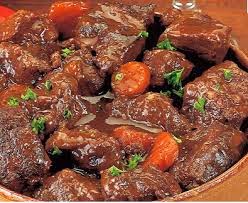
French Provencale casserole

In the 1700's the Dutch imported slaves from their colonies in the Dutch East Indies. They came to be known as Cape Malays. Many were employed as cooks and forever altered Cape Dutch cuisine with the addition of tropical spices.
Sosaties, a Malay dish of skewered meat,
 marinated in a mixture of spices.

When the British took over the Cape Colony from the Dutch in 1815 they brought with them the British-Indian cuisine (such as "curries" and "chutneys") that they had come to enjoy during their colonization of India.

In the late 1800's the British transported indentured workers from southern India to tend the sugar-cane plantations in the Natal Colony. They brought their hot and spicy curries, using a lot of chili, coconut, tamarind, garlic and ginger. They also introduced the naan and roti breads which are first cousins to "askoek" and "pannekoek".
Curries and naan bread

Soon merchants from the northern Indian state of Gujerat migrated to Natal independently. (Among them was Mahatma Ghandi who lived in South Africa for 21 years.) With them, from the north of India, came their aromatic and complex, predominantly vegetarian cuisine.

The pioneers who trekked into the interior of the continent needed to take supplies that were light and nourishing: from them we got biltong, dry boerewors and rusks.
Dry rusks: delicious dunked in coffee!

Until the advent of the railways, “transportryers” with ox wagons took supplies to the gold fields and to the outlying districts. They perfected “potjiekos”: a slowly simmered stew of layered meat and vegetables, made in a three-legged cast iron pot over a few coals at the outspan.

All these strands make up the tapestry of our traditional cooking. Over the centuries there have been outstanding exponents of the culinary art: Miss Hildegonda Duckett, Louis Leipoldt and SJA de Villiers to name but a few.  

Miss Hildegonda Duckitt, the grande dame of Cape cooking, was a granddaughter of William Duckitt, who arrived at the Cape in 1800. She spent her early life on the farm Groote Post, baking mosbolletjies using fermented grape juice instead of yeast to make the dough rise. Her tea cakes, called oblietjies , were also a hit after she revved up an old Huguenot recipe and added cinnamon and white wine. And for children she would make tameletjies: sweets of naartjie peel and pine nuts.  For the cold farm nights on Groote Post, egg flips would be made from a bottle of Madeira, five eggs, cloves, nutmeg and the ubiquitous cinnamon.

Hilda learnt her speciality - tortoise, scalloped with breadcrumbs, butter, lemon and salt - from Abraham, a Swahili cook on the farm. The trick was to scratch the tortoise on the back until its inquisitive head popped out - and then chop it off. Tortoise, like most exotic white meat, is reported to taste like chicken.
She also had an interesting list of home remedies: here are a few from ‘Hilda’s Diary of a Cape Housekeeper’, published 1902:  

Ø  Cure for Toothache. – Mix 60 grains cocaine, 1 teaspoonful tincture of opium, and bottle.  A tiny piece of cotton-wool steeped in this and put in the cavity of the aching tooth will give instant relief.  (I bet it will!)

Ø  Overdose of Laudanum, etc. -  In case of an overdose of laudanum or opium or alcohol, immediately administer an emetic of mustard-and-water, and above all keep the patient awake and in motion, slapping him with wet towels and trotting him up and down the room till a doctor can attend.

Ø  Jaundice  -  The yellow flowers of the wild hemp, known at the Cape as “Dacha”, Cannabis sativa (the leaves of which plant used to be dried and smoked by the natives), made into a tea and taken three times a day, is most efficacious. (Now that has to be better than Rooibos!)

"No, really, Sergeant, trust me, the cocaine, the opium and the dagga are for medicinal purposes only!"
 Those were the days!!


The celebrated Afrikaans poet C Louis Leipoldt (1880-1947) wrote some fascinating and engaging cookery books. They contained not just recipes, but anecdotes and musings of this great writer who was also a bushveld doctor, medical specialist, botanist, chef and all-round epicurean.

 
SJA de Villiers is South Africa's answer to Mrs Beeton. She will always be remembered for her definitive Kook en Geniet, which first saw the light in 1951 and is to be found in the kitchen of every South African housewife. The first English edition, Cook and Enjoy It, appeared in 1961. Nearly a million copies of the two editions had been sold by the turn of the century.


Saturday, 26 April 2014

The Couch Potato Goes Deco


Art Deco Icons.
The complete series [DVD] 
presented by David Heathcote.

Art Deco is synonymous with glamour: Fred and Ginger, Busby Berkeley, Tamara de Lempicka, cocktails and long cigarette holders on ocean liners.  Settle down on the couch for a look at the 1930s through neon-tinted spectacles as David Heathcote guides us round four of Britain's Art Deco icons.

First we spend a night at Claridge’s Hotel in London’s Mayfair. I hope the BBC picked up the check! The art deco suite is glamorous yet comfortable; we are allotted our own butler/valet, who starts by unpacking and putting everything away. Sinking chin-deep into a bubble bath, we notice two bell-pulls beside the tub: one for the butler and one for the maid. The mind boggles.

We explore the hotel's Art Deco makeover of the 1930s, which transformed it from a staid Victorian establishment into a fashionable, up-to-the-minute destination for the rich and famous. The sign above the smoking room door says Fumoir, and the room positively exudes sophistication. You expect to see Paul Heinreid lighting two cigarettes and giving one to Bette Davis. Smoking was sexy and glamorous in the Thirties!

Next stop is the 10-storey London Trans-port HQ. When it was built in the 1930s, it was the highest skyscraper in London. It was an ambitious and controversial design that incorporates a lot of Deco features, but I didn't think it was really a typical example of an art deco building. 

What I liked much more, was the tour of several art deco tube stations from the era, the magnificent collection of London Transport posters, and the old kiosks and signs in the museum. Is anybody else old enough to remember those enamelled WAY OUT signs, with the pointing hand emerging from a perfectly starched cuff?  

Next we visited Casa Del Rio - a remark-able Art Deco house hidden away in rural Devon. I had never heard of it before. It was built in the 1930s by Walter Price, who visited California and fell under the spell of Hollywood. He decided to recreate Pickfair, the glamorous mansion of Douglas Fairbanks and Mary Pickford, on a hillside in Devon, facing the sea. Very beautiful, seen from below.

Casa del Rio is a transplanted Hollywood Spanish hacienda, its Deco interior complete with black-and-white marble floors, marble staircase whose treads look like piano keys and lots of chrome, black glass, and mirrors. 

I liked the electrical gadgets that were the hallmark of stylishness in the era when anything American was considered modern and cutting-edge. The not-quite-automatic toaster, the Bakelite radio, the futuristic (now retro!) cocktail shaker … very glamorous but seen through modern eyes a bit lame. Quite endearingly so!

For our final adventure, we board the Orient Express at Victoria Station in London and head off for Venice. (It is interesting to compare this episode to the Orient Express documentary with David Suchet, also a BBC production.)

Fellow-passengers are James and Shirley Sherwood. James bought fifteen much-neglected Orient Express carriages in the Seventies, including the two in which Agatha Christie's Murder on the Orient Express was filmed. James and Shirley talk engagingly about the challenge of restoring the original Art Deco luxury of the romantic train.

I liked the luxurious, yet practical fittings of the sleeping compartment and the elegant, beautifully appointed bar and dining compartments. The Alpine scenery is also spectacular. 

I'm sure the passengers enjoyed their three days' opulence on wheels, but they would have to be relieved to disembark in Venice, because for all its luxury, the train has no air conditioning and the washing facilities are a bit basic: no shower!


Thursday, 17 April 2014

The Couch Potato Does Spring Cleaning


Petworth House in Sussex is one of those Stately Homes of England of which Noel Coward sang so eloquently. The oldest parts of the fortified manor house founded by Henry de Percy in the 13th century, still survive, but the mansion was extensively rebuilt in 1688 by Charles Seymour, 6th Duke of Somerset. For the past 250 years the estate has belonged to the Wyndham family: the current head of the family is Lord Egremont. The house and deer park were handed over to the nation in 1947 and are now managed by the National Trust. Lord Egremont's family live in the south wing, allowing the remainder to be open to the public.
Interior
The house contains an important collection of furniture, paintings and sculptures, including works by J. M. W. Turner and Van Dyck, exquisite, fragile wood carvings by Grinling Gibbons, and unique classical sculptures. There is also a 1592 terrestrial globe, believed to be the only one in the world still in its original state.

"Petworth House: The Big Spring Clean", is a fascinating BBC series of six episodes, narrated by the genial and erudite Andrew Graham-Dixon.

Every autumn, the Trust puts its 300 houses 'to bed', They close to visitors for the winter, and the professional conservationists move in to clean the artworks and the house itself. This work requires not just hard labour, but delicate hands and an in-depth knowledge of conservation science.

They work in almost freezing conditions and behind closed shutters. Heat and sunlight are bad! Paintings and furnishings fade, bugs breed, mould grows! Andrew dons his winter woolies, warm beanie and boots, and pitches in to help. The magic that happens in these winter months is a miracle to behold, as we get a close look at wonderful art treasures and the very fabric of the house.  

It is not a matter of dusters and vacuum cleaners – many of the art works are too delicate to touch even with a feather, and have to be cleaned by that thing the dentist uses to puff a bit of cold air on your tooth. They puff the dust away and suck it from the air with a funnel. The carpets have to be rolled back to expose the insect eggs that were laid during the summer, scaffolding is erected to clean the mouldings and ceiling paintings. The clocks and the curtains, the paintings, furniture and the kitchen utensils are all cleaned and tended by specialists, the acres of parquet floors are rubbed with beeswax by hand, on bended knee.
Having watched this series, I will be wearing a hazmat suit next time I visit a Stately Home, because  now I know how much grime I am shedding and how much damage my mere presence is creating!

I borrowed the series from the Eastern Regional Libraries. 


The Escher Museum


Visiting the world's great art museums, we sometimes overlook the many small museums which house wonderful things to see, in interesting and historical buildings.
Metamorphosis: Birds into Fishes
One such is the Escher Museum in The Hague. It is housed in what the Dutch call merely Het Paleis (The Palace), as if it were the only palace in town. (It isn't.) It sits at the top, or posh, end of a long, leafy boulevard lined with ambassadorial residences. You will know which is the American one because there is a tank parked outside it, lowering the tone.


Het Paleis used to be the residence of Queen Emma, the great-great-granny of the present  king. She acted as regent after her husband King Willem III popped his clogs, while her daughter, Crown Princess Wilhelmina, was under age.

The former Princess Emma of Waldeck and Pyrmont was 20 when she married the 62-year old king, once described as "the greatest debauchee of the age." He had previously been rejected by Emma's sister Pauline and a few other assorted princesses.
King Willem-Alexander and Queen Maxima of the Netherlands,
with Princesses Amalia, Alexia and Ariane 

My Dutch friend Arno filled me in on all the royal goss: The Oranges are nearly as soap-operatic as the Windsors! Richer and better looking than the Windsors,though, if plumpish. Who can blame them if they put on a few kilos, with all that tempting Dutch cheese. On the upside, they have endless rows of shining white teeth from all the calcium.


Anyway, there it is, Emma’s palace, more of a big posh house than a palace really, but very rococo and they were not shy with the gold paint. There is a very grand staircase, which only Queen Emma and her two favourite ladies-in-waiting were allowed to use. It was the backstairs for everyone else. Luckily there are lifts for the museum visitors today. The grand staircase is still roped off!


I’m surprised Queen Emma didn’t break a leg, because every doorway has an inch-high lintel for the unwary to stumble over. A stripe of that gold paint on the floor to draw attention to the hazard would have been a good idea, but sadly I saw no suggestion box. I don’t suppose Queen Emma took kindly to suggestions … I saw pictures of her and she was a stocky little doorstop of a woman who didn’t look as if she brooked backchat.

About the collection I don’t need to tell you … all the Eschers you have ever seen on posters and coasters, are there. The really good bit is on the top floor, where they have all these optical illusions and trompe l’oeil stuff.

You can look through peepholes into cabinets where the picture is in 3D and the birds and animals move, and you can don virtual reality goggles and step right into some of the pictures – those ones like the Belvedere, where the stairs go nowhere, and the one where down is up, and the one with the chequered floor and the ladders that reach impossible places. It is a lot of fun. You can watch the birds metamorphosing into fishes; thank goodness we are dealing here with Maurice Escher and not with Franz Kafka!

I spent the whole afternoon there and my brain was fizzing all the way home.


The Grand Budapest McGuffin


As long as there have been stories, there have been McGuffins, but it took that fat, sleazy old genius Alfred Hitchcock to give them a name. (People who are both a genius and a really, really nice person are very rare. Try to name three.)

 In 1935 Hitchcock filmed John Buchan's thriller, The 39 Steps. The story revolved round the hero's attempts to stop a spy organisation from  stealing a Top Secret document. It doesn't matter what the document is. It might just as well have been a diamond necklace or a distressed damsel that he was trying to keep out of their evil clutches. Hitchcock came up with "McGuffin" for the item that drives the plot.

The McGuffin needn't even be anything tangible. In North by Northwest, Cary Grant spends the entire film falling into one scrape after another as he is pursued by both villains and the CIA, all due to a case of mistaken identity. Who he is mistaken for and what the pursuers want from him when they catch him, is incidental. It's just the McGuffin that leads the story from one suspenseful sequence to the next.

Now that The Grand Budapest Hotel is in all the cinemas and racking up the favourable reviews, it is a safe bet that our members will be queueing up for tickets and choc-tops at the local  multiplex. I thought this would be a good time to take a look at the film's McGuffin, a priceless Renaissance masterpiece called Boy With Apple, by the artist Johannes Van Hoytl the Younger.

You will search your art encyclopedia in vain for Van Hoytl – the picture was painted for the movie by artist Michael Taylor, who had his tongue firmly in his cheek. He has laden it with enough symbolism for a dozen Art History lectures and several doctoral dissertations.

We have the mysterious note pinned to the curtain, the boy's direct gaze, his extravagantly detailed codpiece and the way he holds his long, slender fingers in a gesture which is a conventional mannerist device expressing a sensual tone. Add the apple in his hand, in close proximity to the prominent codpiece. The apple itself is symbolic on many levels, both biblical and classical. Eve's apple of temptation, the golden apple with which Paris chose the goddess Venus ... and just for a bit of added ambiguity, the apple has a few Caravaggio-like blotches on its surface: it is already beginning to decay.

Is the young man looking to choose a wife or a lover? Is the blemished apple symbolic of a doomed love affair?  Or is it a portent of mortality – does he have a dread disease of which he is yet unaware?

What fun Michael Taylor must have had, painting that portrait. And what fun for us, the audience, when we get the Art History in-joke: the villain is so enraged when he sees Boy With Apple is missing, that he smashes the picture that has been hung up in its place. The replacement is immediately recognisable to us as a real-life Egon Schiele, a priceless teasure he’s obliterated in his fury at losing a fictional  McGuffin.